
Tag: IBM
Five AI Risks That Can Get You Fired—And How to Avoid Them
The Signal
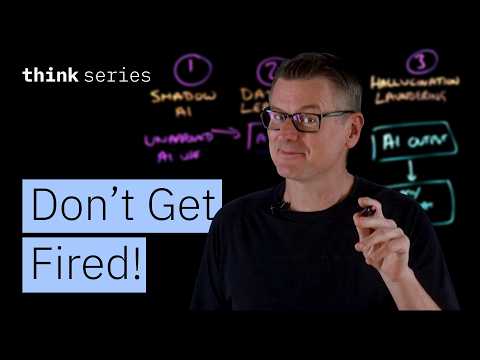
Expert commentary frames five distinct AI-related behaviors—shadow AI, data leakage, hallucination laundering, prompt injection, and unauthorized agents—as risks to career security. The central tension lies in the shift of accountability from AI tool to human user; the speaker argues that adopting these tools without formal governance or verification turns professional efficiency into liability. While the transcript warns of potential firing, it correctly attributes these outcomes to a lack of oversight rather than the inherent nature of AI itself.
The Case
- Shadow AI, where employees route around IT blocks using personal devices or unapproved tools to perform work, preserves risk while blinding IT to data exposure.
- Indirect prompt injection allows attackers to embed malicious instructions within routine files like emails or web pages, posing a deeper security threat than direct prompts.
- Zombie AI agents—autonomous systems left running with active API keys after a project concludes—act as unmonitored backdoors that are easily forgotten by both deployers and IT.
- Hallucination laundering shifts professional negligence onto the human user, as the person who submits AI-generated work as their own bears the credibility cost of any fabrications.
- The speaker claims 1 in 5 organizations have reported a data breach linked to shadow AI, though this statistic—drawn from an unnamed IBM report—remains unverified within the transcript.
- Corporate accountability in the event of an AI exploit rests on the deploying team’s ability to prove they implemented adequate governance, regardless of whether the AI's breach was malicious or accidental.
The 1 Minute Signal Take
The video serves as a sober, practical guide for identifying common organizational failure points rather than a technical critique of AI models. It successfully differentiates between systemic risk and individual user error, though its claims regarding the frequency of firing are anecdotal illustrations rather than empirical data. Watch it if you need a non-technical taxonomy of AI-related security vulnerabilities to bring to your next operations meeting; skip it if you are already familiar with the basics of corporate AI governance.
Time saved:
Tags
Tag: IBM