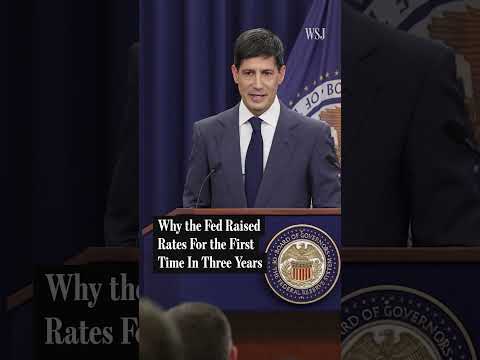
WSJ's Nick Timiraos Gives His Take After the Fed Meeting

Video thumbnail: WSJ's Nick Timiraos Gives His Take After the Fed Meeting
Sep 16, 20261m 57s video lengthThe Wall Street Journal

The Signal

The Federal Reserve has raised interest rates for the first time in three years to prioritize price stability, a move that signals a potential cycle of tightening rather than a isolated adjustment. This decision arrives amid a volatile pre-election backdrop where rising gas prices and persistent inflation are already pressuring the political landscape.

The Case

Policy and Projections

  • The Federal Reserve raised interest rates after a three-year pause, with leadership explicitly citing the need for a timelier return to price stability.0:00
  • Most officials have already signaled expectations for at least one additional rate increase this year, suggesting this hike is likely not a "one-and-done" event.0:24
  • Fed Chair Kevin Worsh reframed the policy as "removing a dose of accommodation," which implies the committee currently views interest rates as still stimulative rather than restrictive.

Market and Political Context

  • Bond-market volatility had already driven up long-term borrowing costs—such as mortgage and car loan rates—even before the Fed formally acted.1:03
  • The decision was finalized just weeks before congressional midterm elections, a period when Republicans are already on the defensive regarding the national cost-of-living crisis.
  • Renewed hostilities in the Middle East are causing gas prices to rise again, adding a new layer of inflationary pressure to an already sensitive political environment.
  • While the White House publicly pledged "100% support" for the Fed Chair's decision, reports indicate potential private discomfort from Donald Trump; observers interpret the public backing as a possible temporary truce.1:32

The 1 Minute Signal Take

The Fed is attempting to get ahead of inflation, but the move highlights how financial conditions were already tightening independently through bond markets. Investors should treat this hike as the beginning of a sustained policy shift rather than a corrective anomaly.

Pro Analysis

Why It Matters

The Fed’s return to a hiking cycle signals an end to the era of 'easy money,' forcing a recalibration of debt-heavy sectors like real estate and automotive finance. This shift is particularly impactful because it coincides with a fragile political cycle where inflation is the dominant voter concern.

Strategic Implications

Businesses and investors must stop expecting 'one-and-done' pivots. The Fed's new framing implies a commitment to higher rates for longer, as officials believe there is still excessive stimulus in the system. Long-term corporate debt strategies should be adjusted for a higher-rate environment that may persist through the next fiscal year.

Evidence & Hype Audit

The content relies on reliable reporting regarding Fed proceedings but leans on speculative political interpretation. The causal link between 'Middle East hostilities' and domestic gas price hikes is asserted as fact without evidence, typical of short-form political journalism.

Counterarguments

Critics might argue that by raising rates, the Fed is needlessly intensifying a recessionary risk just as the bond market is already doing the heavy lifting of tightening credit conditions, potentially causing an 'over-correction.'

Who Should Care

  • Investors: Watch for 'accommodation' language shifts in minutes to gauge the Fed's terminal rate.
  • Homebuyers: Higher mortgage rates are being driven by bond markets more than policy, so monitor long-term yield trends.
  • Political Strategists: The proximity to midterms makes the Fed a prime scapegoat for incumbent parties struggling with inflation.

What to Do Next

  • Analyze long-term Treasury yields daily to forecast upcoming mortgage rate changes.
  • Evaluate corporate balance sheets for exposure to high-interest debt renewals.
  • Track upcoming official Fed projections for signals of a potential pause in early next year.
  • Follow reports on the White House-Fed dynamic; a breakdown in this 'truce' would create extreme market volatility.

Share this

Tags

Written by: 1 Minute Signal Editorial Team