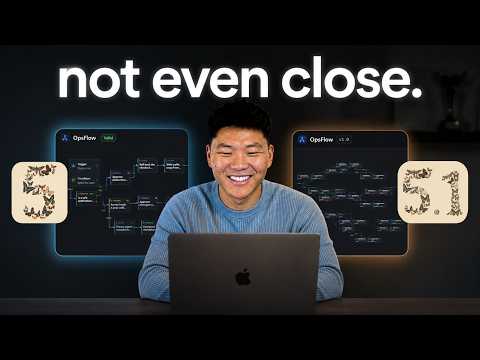
I Had Fable 5.1 and 5 Build Me the Same App

Video thumbnail: I Had Fable 5.1 and 5 Build Me the Same App
Sep 3, 202612m 37s video lengthNate Herk | AI Automation

The Signal

Two agents tasked with building an incident-response simulator from identical prompts produced significantly different software builds, highlighting a clear tradeoff between model-driven polish and operational efficiency. While Fable 5.1 received higher professional marks for UI and hierarchy, Fable 5 proved more cost-effective and faster to build, challenging the assumption that higher-performing models are always the better investment.

The Case

Build performance and costs

  • Fable 5.1, which leaned heavily on the more expensive Opus model for architecture and design, cost over twice as much as Fable 5 and required three times the development time.9:10
  • Fable 5 relied primarily on Sonnet, a more efficient model, resulting in a significantly lower price tag while still delivering a functional application.9:34
  • The speaker notes that Fable 5.1’s 404,000-token context usage nearly doubled that of Fable 5, suggesting that the model mix and orchestration strategy directly drove the performance gap.11:01

Product quality and trade-offs

  • An external, blind review by CodeX gave Fable 5.1 a 9.1 score and Fable 5 an 8.4, citing Fable 5.1's superior information hierarchy and more readable run-state logs.7:44
  • Fable 5 demonstrated deeper authoring controls, such as better negative test presets and live preview features, though the speaker found some UI elements—specifically text scaling—to be less polished.8:35
  • Interoperability differed between versions, as Fable 5.1 successfully imported a JSON schema that Fable 5 rejected, and the builds varied in how they handled error mitigation during simulated incidents.6:19

The 1 Minute Signal Take

The speaker’s split preference—favoring Fable 5.1 for general knowledge tasks but Fable 5 for this specific engineering challenge—confirms that model selection should be benchmark-specific. When production efficiency is the priority, leaner model architectures often yield higher value outcomes than more expensive, model-heavy configurations, even if the latter appear more sophisticated in head-to-head testing.

Pro Analysis

Why it Matters

This comparison demonstrates that AI agents are not monolithic; they are essentially different 'org charts' of models. It shifts the discussion from 'which model is smarter' to 'which model manages its resources more effectively,' which is the critical transition from academic capability to enterprise utility.

Strategic Implications

Businesses must move away from choosing a single 'model for all tasks.' Instead, they should implement tiered orchestration where low-cost, high-speed models (like Sonnet) handle standard iteration, and expensive, high-reasoning models (like Opus) are reserved for architecture or high-stakes decision points.

Evidence & Hype Audit

The content relies on the speaker’s anecdotal testing and a 'CodeX' blind review. While the metrics (time, cost, score) are specific, they lack the rigor of a true controlled scientific study. The results are highly trustworthy for understanding the 'vibe' of the difference but should be viewed as a single data point rather than a universal model benchmark.

Counterarguments

A contrarian might argue that a 0.7-point difference in a subjective review score is statistically insignificant compared to the consistency gained by using a single, high-performance model for all tasks. Relying on Fable 5 for cost-saving might introduce long-term technical debt if the lower-cost build is fundamentally less maintainable.

Who Should Care

  • Product Managers: Need to balance UI/UX polish against development time.
  • Engineering Leads: Should focus on the orchestration architecture (prompting for delegation) rather than the model brand.
  • Budget Analysts: Need to account for the drastic variance in 'agentic burn rate' when scaling AI development.

What to Do Next

  • Define clear 'Definition of Done' criteria to prevent agents from stopping at 'plausible' but unfinished code.
  • Perform a cost-benefit audit of your current AI workflows to see if you are overspending on Opus where Sonnet would suffice.
  • Implement standardized negative-test presets in your agentic workflows to improve error handling consistency.
  • Map out which parts of your application-building pipeline are aesthetic (high-cost) versus functional (high-speed).
  • Conduct your own internal blind comparison using a standardized prompt to see how different model mixes affect your specific use case.
Time saved:9m 19s

Share this

Tags

Written by: 1 Minute Signal Editorial Team