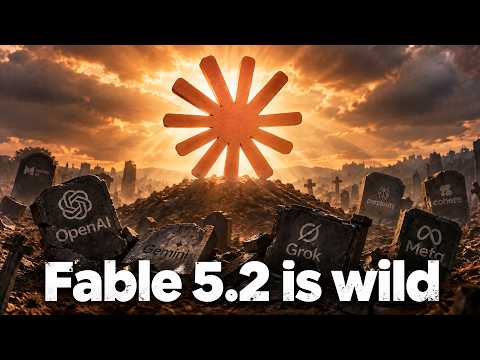
My $1,000 Fable 5.2 Workflow (just copy me)

Video thumbnail: My $1,000 Fable 5.2 Workflow (just copy me)
Nov 12, 202630m 41s video lengthDavid Ondrej

The Signal

David Andre, a developer and agent-workflow enthusiast, argues that current frontier AI work requires a multi-model orchestration strategy rather than a single default model. He posits that Fable 5.2 is superior for planning and complex technical tasks, while Opus 5.5 remains the more efficient engine for routine execution, and Gemini 4 Carbon functions as an ideal third-party auditor.

The Case

Workflow Strategy

  • Andre advocates for an "Fable-first" approach: use Fable 5.2 to navigate uncertainty and establish a plan, then switch the same thread to Opus 5.5 for faster, cheaper execution once the task is clear.5:45
  • He reports hitting Fable usage limits 53 times in three days, compared to only two for Opus, highlighting why he splits work across multiple subscriptions and models.2:43
  • Cost is framed by "completed task" efficiency rather than API token pricing, arguing that smarter, larger models are often cheaper overall by requiring fewer steps and tool corrections.9:54

Automation and Review

  • Gemini 4 Carbon is positioned as the primary review model for work produced by Anthropic or OpenAI-family models; its differing architecture is credited with catching unique edge cases that primary models miss.12:54
  • Automation relies on persistent "loops" for security, health checks, and PR reviews; 72% of these run on Opus 5.5 due to its reliability, while Fable is rarely used here to avoid unnecessary usage drain.27:04
  • Productivity is anchored in a library of reusable "skills" and "snippets," which accounted for 34% of his manual prompts over the observed three-day window.3:55

Tooling and Ecosystem

  • He promotes Cloud Room, an open-source development environment, as the central hub for managing his various agents, harnesses, and continuous monitoring loops.1:00
  • The stack requires significant investment, with Andre maintaining multiple $200-per-month subscriptions to ensure he has consistent access to frontier-model capacity despite frequent usage limits.1:21

The 1 Minute Signal Take

The most practical takeaway is that model selection should be modular—using high-reasoning models for strategy and high-throughput models for implementation. If you are doing serious agentic development, stop looking for a universal 'best' model and start building an orchestration layer that routes tasks by complexity and cost.

Pro Analysis

Why It Matters

This content shifts the focus from 'which model is the best' to 'how to orchestrate a fleet of models.' As agents become the primary interface for software development, learning how to partition intelligence—planning versus execution versus review—becomes a critical professional skill.

Strategic Implications

  1. Tooling Maturity: The move toward agent-development environments like Cloud Room suggests that the next generation of productivity tools will be agent-native, prioritizing workflow orchestration over simple chat interfaces.
  2. Economic Lens: By ignoring API costs in favor of task-completion throughput, the speaker highlights that frontier model spending is an investment in human time savings, not just an operational cost.

Evidence & Hype Audit

  • Trustworthiness: Low to Moderate. The workflow is highly specific to the speaker’s personal preferences and promoted software. His benchmark claims are based on internal interpretations rather than broad, third-party verified data.
  • Bias: The content is heavily promotional toward 'Cloud Room' and his 'New Society' community. Take the performance statistics (e.g., '43% more productive') as illustrative claims rather than scientific facts.

Counterarguments

  • Tool Complexity: A multi-model, multi-subscription, multi-harness stack adds significant management overhead. For many developers, the cognitive load of maintaining this complex infrastructure may outweigh the productivity gains.
  • Model Obsolescence: Relying on a highly manual, custom-coded agent environment can leave users vulnerable if the underlying APIs or environments shift or break.

Role-Specific Takeaways

  • Engineers: Focus on building a library of reusable 'skills' and snippets to standardize common coding tasks.
  • Managers: Treat AI subscriptions as productivity tools. Don't worry about the $200 sticker price if it replaces hours of expensive human technical debt.

What To Do Next

  • Audit your current workflow for repetitive tasks that can be converted into reusable prompt snippets.
  • Evaluate if you are using 'over-powered' models for routine tasks and experiment with switching to a faster model for execution.
  • Test the multi-model review pattern by having a different model family critique your latest code or technical draft.
  • Identify one persistent manual task—like security checks or log monitoring—and attempt to script a simple 'loop' to automate it.
Time saved:27m 7s

Share this

Tags

Written by: 1 Minute Signal Editorial Team