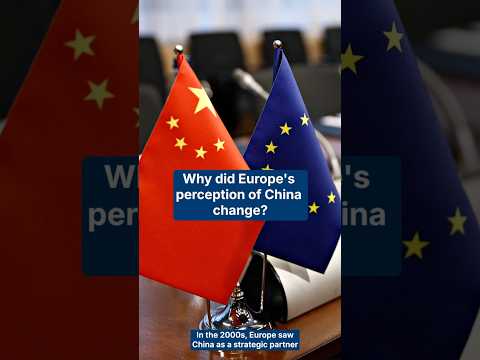
Why did Europe's perception of China change?

Video thumbnail: Why did Europe's perception of China change?
Aug 5, 20262m 30s video lengthBrookings Institution

The Signal

Europe’s perception of China has undergone a four-phase transformation since 2001, shifting from optimistic economic partnership to guarded strategic rivalry. The current tension centers on whether China is now weaponizing Europe’s economic dependencies and providing decisive, material support to Russia, fundamentally challenging the continent’s long-standing 'change through trade' paradigm.

The Case

The Shift in Engagement

  • The initial phase after China joined the WTO in 2001 was rooted in the German concept of "Wandel durch Handel"—a belief that deepening trade ties would inevitably liberalize China’s political system.0:11
  • By 2015, the publication of the "Made in China 2025" strategy signaled to European policymakers that Beijing was not prioritizing reciprocal growth but was instead leveraging European markets to gain strategic industrial advantages.0:46
  • The 2016 acquisition of KUKA, a German robotics manufacturer, served as the peak concrete example of this perceived asymmetry, crystallizing fears over Chinese state-directed investment.1:14

Current Strategic Realities

  • The 2019 EU strategic assessment formally codified a shift by classifying China as a partner, a competitor, and a systemic rival that promotes alternative governance models.
  • Several distinct frictions have since accumulated, including concerns over unfair trade practices, the role of Huawei in digital infrastructure, cyber espionage, and human-rights crackdowns in Xinjiang and Hong Kong.1:38
  • Since Russia’s 2022 invasion of Ukraine, the perception has hardened; the speaker asserts that China is providing full support to Russia and that Europe now faces the risk of China weaponizing its existing trade dependencies for political coercion.1:57

The 1 Minute Signal Take

Europe is no longer balancing China as a purely economic actor, having moved toward a security-first framework that treats interdependence as a liability. The transition from growth-focused optimism to a defensive posture reflects a broader realization that trade integration does not inherently force political convergence.

Pro Analysis

Why It Matters

This shift represents the death of the neoliberal assumption that economic integration is a prophylactic against geopolit...
Full analysis always available on Pro.

Time saved:52s

Share this

Tags

Written by: 1 Minute Signal Editorial Team