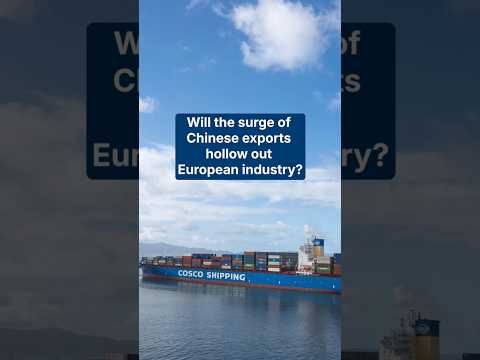
Will the surge of Chinese exports hollow out European industry?

Video thumbnail: Will the surge of Chinese exports hollow out European industry?
Aug 6, 20261m 37s video lengthBrookings Institution

The Signal

Europe’s response to China’s economic scale is currently stuck in a defensive, reactive posture, despite a window for proactive intervention having already passed. The central tension lies in the necessity of collective Western coordination to counteract China’s structural influence, which remains difficult due to existing institutional friction and deeply entrenched trade principles.

The Case

  • The speaker frames Europe’s situation using the proverb that the best time to act was 20 years ago, but the second-best time is now; he acknowledges that Europe is currently developing and proposing policy tools, though he views this response as defensively constrained.0:08
  • The core strategic argument is that no individual nation can counter China’s massive scale, making a collective Western effort the only viable remedy for shifting from a defensive to an offensive posture.0:35
  • This alignment is described as a significant challenge because Europe lacks a model parity with Japan and Korea while simultaneously harboring political friction with the United States.1:16
  • While the post-war trading system is credited with providing decades of global prosperity and growth, the speaker asserts that China’s state-led model now poses a fundamental threat to these longstanding rules.0:53
  • The speaker expresses explicit uncertainty regarding the potential depth of U.S.-European coordination, noting that moving away from established trade principles to address this challenge is proving to be immensely difficult.

The 1 Minute Signal Take

The speaker’s diagnosis highlights an asymmetry between the necessary strategic response—coordinated Western scale—and the political reality of a fractured, defensive Europe. Success depends on whether Europe can transcend internal and alliance-level disagreements to pivot from reactive policy-making to a unified economic stance.

Pro Analysis

Strategic Implications

The speaker highlights a classic 'first-mover' dilemma in geopolitics: Europe has essentially ceded the initiative, and is now trying to catch up in a system where the rules are being rewritten by the competitor. This suggests that the future of Western trade will be defined not by open markets, but by 'industrial alliance blocks.'

Evidence & Hype Audit

This content is analytical rather than empirical. It relies on the speaker’s subjective assessment of political sentiment. While it correctly identifies the growing frustration in European policy circles, it lacks specific data on which 'policy tools' are actually gaining traction, making it more of a high-level strategic observation than a granular policy report.

Counterarguments

Some economists would argue that the 'defensive' posture is actually a prudent recognition that trade wars are net-negative for all parties. Moving to an 'offensive' posture could trigger a race to the bottom in subsidies, potentially causing more damage to the European consumer and internal inflation than the current threat from Chinese exports.

Who Should Care

  • Trade Negotiators: Need to understand the shift from rules-based trade to power-based economic bargaining.
  • European Industry Leaders: Must prepare for a shift in regulatory landscapes as policy pivots toward protectionist tools.
  • Geopolitical Analysts: Should watch the evolving relationship between the U.S. and EU as they attempt to reconcile their 'model' differences.

What to do next

  • Map current European policy tools against the proposed 'collective' criteria.
  • Evaluate the political stability of U.S.-EU trade relations for upcoming negotiation cycles.
  • Compare the efficacy of Japanese/Korean defensive measures against those currently proposed by the EU.
  • Develop a list of non-negotiable trade principles versus those that could be sacrificed for strategic gain.

Share this

Tags

Written by: 1 Minute Signal Editorial Team