
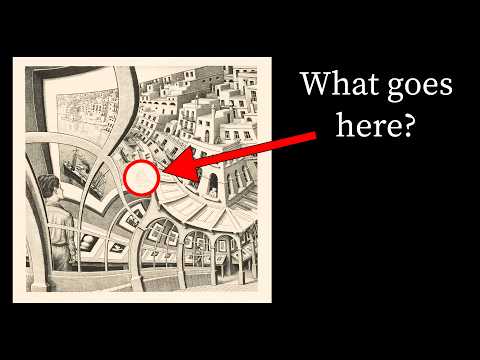
- Escher’s intuition about maintaining local square shapes in a warped grid is mathematically defined as a conformal map.
- The complex exponential function serves as the bridge between linear log-space tiling and the warped, circular composition of the final print.
- The 'hole' in the center of Escher's original work is a decorative artistic choice rather than a mathematical necessity, as the base function extends infinitely.
- Elliptic functions, which describe doubly periodic complex mappings, provide a theoretical framework for potential advances in generating infinitely recursive visual art.
Channel: 3Blue1Brown
How (and why) to take a logarithm of an image
This content explores the intersection of art and mathematics by analyzing how M.C. Escher used geometric principles and complex number theory to design the recursive, self-contained loop found in his lithograph, Print Gallery.
Key Takeaways
- The recursive structure in Escher’s work can be rigorously modeled using complex functions, specifically through logarithmic and exponential mappings.
- Conformal maps, which preserve shape at an infinitesimal scale, explain why Escher’s warped grid successfully keeps local imagery recognizable despite extreme global distortion.
- Drosta-effect self-similarity is mathematically equivalent to periodicity when viewed through the lens of a complex logarithm, facilitating the creation of looping imagery.
Talking Points
Analysis
Why This Matters
This synthesis of art history and complex analysis demonstrates that human aesthetic intuition often follows deep, underlying mathematical truths. For researchers in computer graphics and topology, understanding why Escher's projections work provides a blueprint for improved non-linear image warping.
Who Should Care
- Computer Vision & Graphics Engineers: The principles here directly apply to image projection, texture mapping, and distortion correction.
- Mathematicians/Educators: It provides a visceral, high-stakes example of complex analysis that renders abstract concepts like branch cuts and conformal mappings approachable.
A Contrarian Takeaway
We often assume human art is 'organic' and mathematical art is 'calculated,' yet Escher provides proof that, at a sufficiently high level, these categories are indistinguishable. The 'feeling' of a puzzle piece fitting perfectly may simply be the human brain's evolutionary hardware identifying low-energy, highly symmetric mathematical states.
Time saved:
Channel: 3Blue1Brown