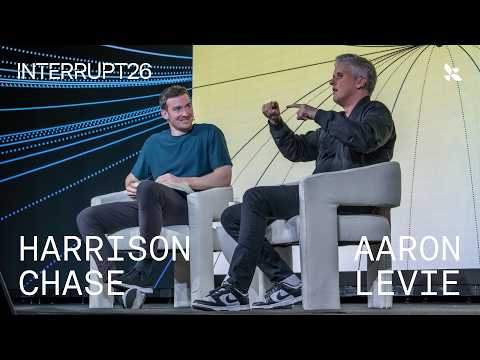
Why Enterprise AI Adoption Is Slower Than You Think — Aaron Levie (Box) + Harrison Chase

Video thumbnail: Why Enterprise AI Adoption Is Slower Than You Think — Aaron Levie (Box) + Harrison Chase
Jun 29, 202631m 28s video lengthLangChain

The Signal

AI model progress is decoupling from enterprise deployment. While frontier capabilities scale rapidly, enterprise adoption remains bottlenecked by non-technical factors: governance, permissions, and workflow integration. Box’s strategy centers on being the bridge for this content-heavy knowledge work, favoring specialized agent harnesses over generic chat interfaces to navigate enterprise complexity.

The Case

  • Coding agents serve as the high-water mark for AI because code is verifiable, coding tasks allow for technical user oversight, and code-centric data is plentiful. Most other enterprise knowledge work lacks these advantages, facing fragmented permissions and opaque, non-verifiable outputs.5:40
  • Box’s legacy architecture, specifically its singular governance and canonical ID model for every file, serves as an unexpected advantage for agents. The platform has adapted by converting content into agent-ready formats, like markdown APIs, and adjusting search signals to accommodate the massive context volume agents ingest compared to human users.12:54
  • Headless integration via protocols like MCP — the Model Context Protocol — is viewed not as a threat to product UI, but as a volume-multiplier. Using Salesforce’s headless API for high-volume market research, the speaker demonstrated that agents can take on tasks that human analysts previously could not feasibly tackle.17:37
  • Token-cost pressure is becoming a primary enterprise constraint, ending the era of 'token-maxing.' Public companies and banks, unlike well-funded startups, cannot absorb infinite AI bills; this forces a transition toward hybrid, multi-model systems where workflows are routed to the most cost-efficient, task-appropriate model.28:42
  • The speaker anticipates a multi-year diffusion period for AI across the broader enterprise, citing this 'cognitive dissonance' between pure model capabilities and slow organizational adoption as evidence that extreme, rapid takeoff scenarios remain unlikely.10:12

The 1 Minute Signal Take

Enterprise AI is shifting from a 'model-first' to a 'bridge-first' phase where infrastructure, governance, and cost-efficiency define the winners. Organizations should stop viewing AI as a monolithic spend and begin building specialized harnesses that treat coding-style verifiability as the standard for all knowledge-work automation.

Pro Analysis

Why It Matters

The transition from experimental AI to operational enterprise software is a fundamental shift in the industry. As compani...
Full analysis always available on Pro.

Time saved:29m 42s

Share this

Tags

Written by: 1 Minute Signal Editorial Team