
- Fly-by-wire control logic is the core requirement for managing seamless mode transitions in tiltrotor aircraft.
- High disk loading gives the V-22 exceptional speed capabilities while simultaneously causing challenging, hurricane-force downwash during landing.
- S-2 fiberglass composites provide the necessary low-impedance vibration damping that metallic yokes failed to offer during testing.
- Engine-out reliability is achieved through a cross-shaft mechanical coupling system that allows a single engine to drive both rotors.
The Insane Engineering of the V-22 Osprey
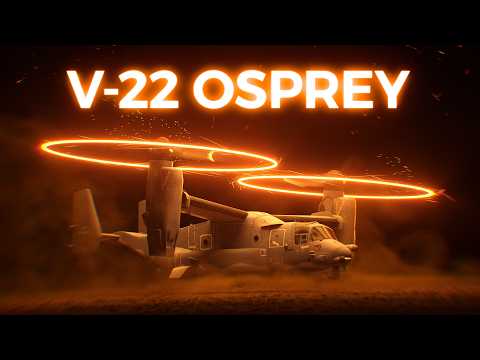
The V-22 Osprey represents a complex engineering achievement that merges helicopter vertical lift with airplane-like cruise speeds. This video explores the technical evolution of the tiltrotor design, from early prototypes to its modern application in high-stakes military rescue missions.
Key Takeaways
- The V-22 Osprey utilizes a fly-by-wire system to master both hover and fixed-wing flight modes.
- Development evolved from the vibration-plagued XV-3 and the refined XV-15 to solve critical structural and propulsion challenges.
- The aircraft's controversial safety reputation appears statistically comparable to conventional military helicopters when adjusted for usage metrics.
- Advanced composite materials and lubrication-free flexible couplings were essential to overcoming severe vibration and synchronization limits.
Talking Points
Analysis
Strategic Significance
The V-22 represents a fundamental shift in expeditionary reach. By shrinking the time-to-target for medical or rescue assets by a factor of hours, it changes the geometry of combat operations where speed is the primary variable affecting survival.
Who Should Care
Military strategists, aerospace engineers, and systems designers should treat this as a case study in how to bridge conflicting design requirements. Understanding the V-22's evolution reveals how software-defined control laws can overcome hardware limitations.
Contrarian Takeaway
The V-22's reputation as uniquely dangerous is largely a function of its novelty and high-profile mission profile rather than its base mechanical failure rate compared to legacy platforms.
Time saved: