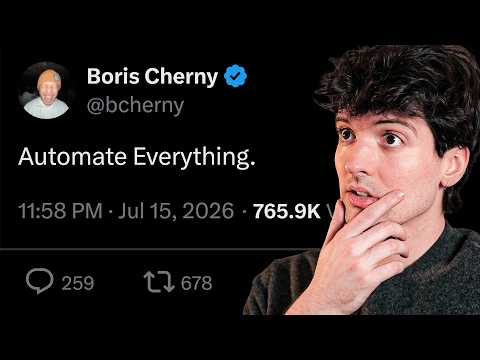
Boris has some really good advice

Video thumbnail: Boris has some really good advice
Jul 21, 202619m 13s video lengthTheo - t3․gg

The Signal

The shift toward AI-agent development has moved the engineering bottleneck from writing code to building automation and steering infrastructure. While agents can now accelerate task completion, their effectiveness hinges on humans encoding domain knowledge into reusable rules, tests, and documentation. This shift changes the definition of seniority, prioritizing systems-building over pure volume.

The Case

The Shift in Engineering

  • The speaker argues that AI-era leverage now comes from creating environment guardrails, such as lint rules and end-to-end tests, which allow agents and teammates to work safely without manual oversight.3:24
  • Engineering value is increasingly found in "steering artifacts"—files like claude.md or custom review documentation—that encode codebase-specific domain knowledge and behavioral constraints.10:03
  • The speaker explicitly warns against letting agents write these steering files, arguing that humans must deliberately maintain them through iterative testing and observation.12:30

Practical Implementation

  • To improve agent output, developers are encouraged to start with minimal context in prompts, adding specific constraints to infrastructure only after observing recurring failures or bottlenecks.16:28
  • Custom developer tooling is becoming more efficient to maintain; the speaker, for example, built a bespoke upload service for GitHub PR videos to bridge gaps in CLI agent capabilities.6:14
  • Beyond technical configuration, the speaker mandates a "one dumb question per day" rule for new contributors to force the surfacing of hidden assumptions and onboarding friction.11:13

Growth and Caveats

  • The speaker frames the "Staff-level" career path as building systems—rather than shipping features—that empower the entire team to be more productive.18:05
  • High-level claims regarding non-engineers contributing "as effectively" as engineers are explicitly qualified by the speaker as "a bit of a reach," acknowledging the current limitations of AI-guided workflows.
  • Operational claims regarding the speaker’s own sponsor, Blacksmith CI—including 3,000 jobs in the last seven days and reduced failure rates—are presented as first-party testimonials rather than independent evidence.3:01

The 1 Minute Signal Take

Seniority in an agent-assisted environment is redefined by your ability to build infrastructure that makes the codebase predictable and approachable for both humans and AI. Rather than chasing every new plugin or agent skill, focus on encoding your team's unique domain knowledge into durable, iterative guardrails.

Pro Analysis

Why It Matters

This content serves as a high-level playbook for the 'second wave' of AI engineering, moving beyond simple code generation into agent-centric infrastructure design. It matters because it redefines the role of the developer, acknowledging that as coding becomes cheaper, the value density has migrated to system observability and constraint management.

Strategic Implications

Businesses that lean into this workflow will likely see a decoupling of headcount from output, provided they survive the initial overhead of building these 'steering' systems. The strategy here is not to replace engineers but to turn them into 'Platform Engineers' for their own internal agent teams.

Evidence & Hype Audit

  • Epistemic Trust: The speaker is transparent about the subjective nature of these claims, explicitly flagging certain arguments (such as non-engineers contributing with parity) as 'a bit of a reach.'
  • Bias: The content carries an obvious sponsorship bias toward Blacksmith CI, though the primary engineering advice remains largely tool-agnostic.
  • Depth: It is high on anecdotal evidence and operational experience, but lacks broad statistical data to support the 'career-accelerator' claims.

Counterarguments

Critics might argue that these practices risk 'over-engineering' codebases for the sake of AI, potentially creating a complex web of proprietary steering documents and custom tooling that adds significant technical debt if the underlying agent models change or if teams rotate projects.

Role-Specific Takeaways

  • Managers: Implement the 'one dumb question' rule to maintain onboarding health.
  • Staff Engineers: Focus on building reusable guardrails and linting patterns that prevent common agent-induced regressive behaviors.
  • Junior Devs: Learn to audit the custom steering files in your repo; that is where the real project philosophy lives.

What to Do Next

  • Conduct a 'friction audit' of your current agent-coding workflow.
  • Explicitly draft a claude.md file if one does not exist.
  • Replace one frequently manually corrected code issue with an automated lint rule.
  • Evaluate your CI feedback latency to ensure it supports iterative AI development.
  • Identify one piece of recurring domain knowledge currently only in your head and document it in the codebase.
Time saved:15m 39s

Share this

Tags

Written by: 1 Minute Signal Editorial Team