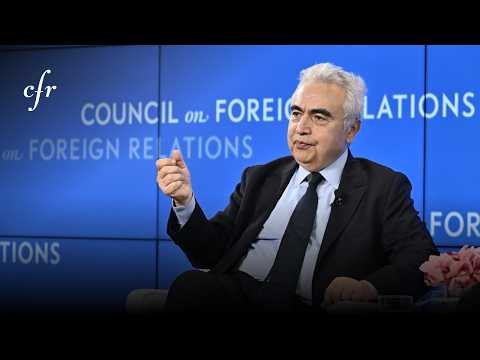
A Conversation With International Energy Agency Executive Director Fatih Birol

Video thumbnail: A Conversation With International Energy Agency Executive Director Fatih Birol
Jul 27, 202658m 56s video lengthCouncil on Foreign Relations

The Signal

Energy security is undergoing a structural shift, moving from just-in-time cost optimization toward a just-in-case model driven by geopolitical distrust. Fatih Birol, Executive Director of the IEA, identifies the unconditional reopening of the Strait of Hormuz as the most critical short-term stabilizer, while arguing that critical-minerals refining capacity—dominated by China—is the next global chokepoint.

The Case

Crisis and Supply

  • The immediate Hormuz disruption is being absorbed by temporary buffers, including a historic 400-million-barrel IEA stock release that reduced prices by roughly $20 and a 4.5-million-barrel-per-day demand reduction by China.8:46
  • These cushions are finite, and the crisis has already seen 84 major energy facilities severely damaged; Birol warns that unless the Strait of Hormuz remains unconditionally open, global markets face significant deficit risks, with developing Asian countries bearing the highest cost.9:28

Structural Vulnerabilities

  • Critical minerals are now a systemic risk, with China controlling 75% of refining capacity across the top 20 minerals; Birol asserts that market forces alone cannot bridge this 8-year diversification gap, requiring a G-7 and IEA-led safety net.19:21
  • The energy transition is being reoriented by security and national-capability concerns rather than climate policy, evidenced by Europe’s tripling of renewable installations and a return to nuclear power following the invasion of Ukraine.29:53

Future Outlook

  • Electricity reliability is the new baseline for economic and geopolitical dominance, with rising demand from AI and data centers driving a global scramble for natural gas and nuclear lifespans; Birol expects small modular reactors (SMRs) to reach commercial scaling by the early 2030s.42:00
  • Energy strategy is increasingly defined by the scarcity of trust, which forces nations to pay a premium for resilient, domestic, or partner-aligned sourcing rather than selecting the lowest-priced supplier.25:56

The 1 Minute Signal Take

Energy strategy has moved from a commodity-price game to one of supply-chain sovereignty and trust. Investors and policymakers should expect this security-driven transition to prioritize domestic nuclear and mineral-refining capacity over decarbonization speed, with Hormuz and data-center power demand serving as the primary lead indicators for market volatility.

Pro Analysis

Why It Matters

Energy policy has entered a high-stakes geopolitical phase where energy is no longer just a commodity to be traded but a ...
Full analysis always available on Pro.

Time saved:57m 4s

Share this

Tags

Written by: 1 Minute Signal Editorial Team