I ran a software factory for a month. Here's what it cost...

Video thumbnail: I ran a software factory for a month. Here's what it cost...
Jul 3, 202611m video lengthJaymin West

The Signal

Jamon West, a forward-deployed engineer, reports that his self-hosted 'Warren' software factory has executed over 1,000 agent runs over seven weeks, with 86% of those tasks happening autonomously. While the system manages 13 projects, including those with real-world users, it remains an unsettled question whether autonomous agents can reliably detect subjective technical debt as effectively as humans.

The Case

Usage and Economic Scale

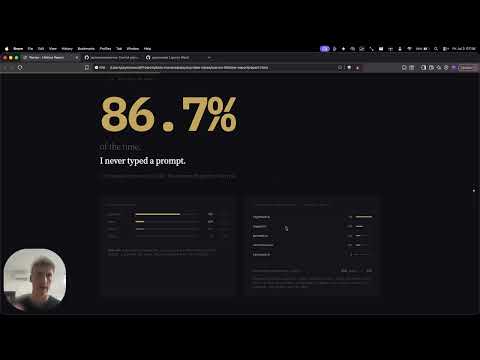
  • The Warren system operates as a cloud-based development pipeline where 86% of runs require no direct human prompts, often relying on pre-written plans instead.2:06
  • Over 1,000 agent runs cost $1,348 between May 14 and July 2, averaging $1.48 per pull request; the system was its own largest consumer, accounting for 57% of those runs and $800 of total spend.0:40
  • West shifted his workflow from local terminal agents to 100% cloud-based orchestration, currently routing 13 projects—including those used by real companies—through Warren.6:01

Reliability and Limitations

  • The system reports a 91% success rate, though 57 runs failed during the tracking period; the most significant failure mode identified was agents simply neglecting to commit their work.7:17
  • Autonomous 'bug watch' agents often fail to identify issues that West detects manually, suggesting that while the triggering of agents is automated, the actual quality of debugging remains inconsistent.4:43
  • West currently uses high-end Opus-class models for nearly all tasks, which he acknowledges is inefficient; he expects costs to drop significantly as he migrates routine tasks to smaller, cheaper models.1:02

The 1 Minute Signal Take

Warren demonstrates that autonomous software development is becoming a viable production utility rather than a mere demo, provided you accept a 9% failure rate and the current need for human oversight on subjective tasks.

Pro Analysis

Why It Matters

This project represents the transition from 'AI as a chat assistant' to 'AI as an autonomous business asset.' By quantifying the utility and failures of an agent-driven factory, West provides a rare, transparent benchmark for what autonomous development actually looks like when subjected to continuous, real-world deployment across 13 repositories.

Strategic Implications

Software engineering is shifting toward a management model where the human role becomes one of system architect and plan-writer, rather than code-author. The ability to route work across multiple projects through a single agentic hub suggests that solo developers or small teams can manage significantly larger codebases by offloading maintenance and 'ratcheting' tasks to models.

Evidence & Hype Audit

This content is highly trustworthy for its transparency, not its perfection. West openly discusses his system's failures (such as the commit issue) and admits to potential overspending. While he functions as a protagonist for his own project, the inclusion of concrete metrics—run counts, specific dollar amounts, and failure rates—anchors the claims in reality rather than marketing fluff.

Counterarguments

The skeptic might argue that 91% success is insufficient for mission-critical infrastructure where an 'uncommitted change' could mean the difference between a functional product and a broken deployment. Additionally, the reliance on high-cost models suggests this workflow may move out of reach for smaller projects unless cost-per-token or model efficiency improves drastically.

Recommendations

  • Instrument for Failure: Implement explicit checks to ensure all agentic changes are actually committed to the remote repository.
  • Standardize Task Granularity: Focus autonomous agents only on 'ratcheting' and maintenance tasks rather than high-level feature development.
  • Implement Model Tiering: Route routine tasks to smaller, cheaper models and reserve Opus-class power for plan composition and debugging.
  • Human-Audit Thresholds: Set specific, irreversible actions (like large refactors) to require a human reviewer until the 'success-to-commit' ratio approaches 99%.
Time saved:8m 1s

Share this

Tags

Written by: 1 Minute Signal Editorial Team