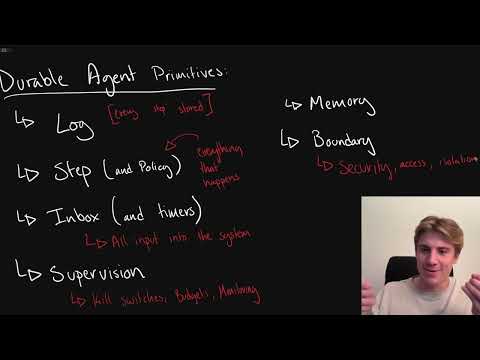
durable agents are actually important

Video thumbnail: durable agents are actually important
Nov 3, 202614m 54s video lengthJaymin West

The Signal

Engineering is shifting from ephemeral chat-based sessions to durable, always-on agents designed for long-running autonomous work. By treating every system action as a logged, resumable step, developers are building agents that maintain state over weeks or months, potentially evolving from simple tools into specialized, coworker-like operators. This shift prioritizes crash recovery and persistent context over traditional conversational memory.

The Case

Architectural Primitives

  • Durable agents rely on a persistent log of every execution step, which allows the system to recover exact state and resume tasks precisely after a crash.2:25
  • Memory is reframed from simple vector retrieval into a persistent system where compaction is a continuous background state, with Claude Code’s idle compaction serving as a key early example.7:47
  • The harness must include an inbox for asynchronous events—such as timers or webhooks—and explicit policy logic to determine whether interrupted tool calls should be retried or skipped.3:14
  • Security boundaries are central to this model, as agents in 'code mode' may write and execute arbitrary scripts that persist over long periods, necessitating strict isolation controls.5:19

Operational Patterns

  • The speaker suggests a move toward 'superfan' agents, which accumulate subsystem-specific expertise over time and escalate anomalies to humans, as seen in nascent payment-monitoring examples.11:47
  • These agents are intended to act less like prompt-driven scripts and more like persistent teammates capable of responding in tools like Slack and understanding deep operational history.13:45
  • While durable agents are currently being integrated into consumer tools like Duet and Muse, the speaker argues they represent a broader transformation of the engineering mental model.0:03

The 1 Minute Signal Take

This is a design framework for building autonomous agents that survive failures and maintain long-term coherence. While the speaker’s forecast of a seismic industry shift is speculative, the underlying technical pattern—event-sourced logging and explicit state management—is a necessary progression for any agent expected to perform reliable, multi-step engineering tasks.

Pro Analysis

Why It Matters

The transition to durable agents represents a fundamental maturation of AI engineering. Moving from 'ask-and-answer' interfaces to 'agent-as-a-service' allows for the automation of complex, multi-step workflows that were previously impossible to entrust to AI due to reliability concerns.

Strategic Implications

Businesses that adopt durable, always-on agent architectures will likely gain a significant operational advantage by automating maintenance and monitoring tasks. This shift forces organizations to confront the reality of AI as a persistent entity within their internal systems, necessitating better governance, budgeting, and security boundaries.

Evidence & Hype Audit

The content relies on an internal, coherent framework rather than external benchmarking data. The speaker is transparent that this is an architectural mental model and forecast. It is high-signal engineering advice rather than shallow product hype, though it leans heavily on the assumption that long-running agents are the inevitable industry direction.

Counterarguments

One might argue that long-running agents introduce 'agent drift'—where persistent, autonomous systems accumulate subtle errors or state corruption that is harder to debug than a clean, short-lived chat session. Additionally, the maintenance overhead of managing durable agent infrastructure may outweigh the benefits for simpler tasks.

Who Should Care

  • Engineering leads building internal agentic platforms.
  • Infrastructure developers focusing on agent observability and reliability.
  • Security architects tasked with defining the 'boundary' for autonomous code execution.

What To Do Next

  • Audit current agent implementations to identify if they support crash resumption.
  • Prototype an 'inbox' pattern to handle asynchronous event processing.
  • Review memory management strategies to move away from constant state re-generation.
  • Define clear 'kill-switch' policies for any agent granted autonomous code execution capabilities.
Time saved:11m 55s

Share this

Tags

Written by: 1 Minute Signal Editorial Team