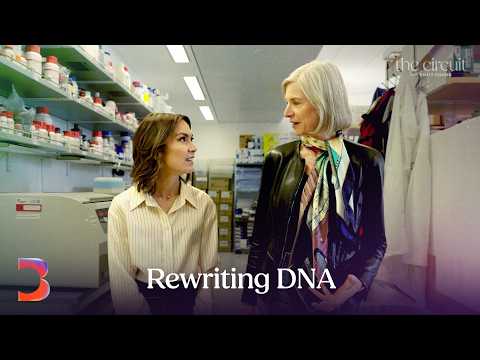
Why AI Hasn't Cured Anything...Yet, According to Jennifer Doudna | The Circuit

Video thumbnail: Why AI Hasn't Cured Anything...Yet, According to Jennifer Doudna | The Circuit
Jun 24, 202624m 2s video lengthBloomberg Originals

The Signal

Jennifer Doudna, the Nobel-winning pioneer of CRISPR gene editing, warns that while the technology has successfully provided a first-of-its-kind personalized therapy for a rare-disease patient, the field’s central challenge has pivoted from discovery to safe delivery and scalability. She remains skeptical of AI’s current capacity to innovate in biology, arguing that experiments remain essential, while expressing concern that eroding U.S. science funding could cede long-term technological leadership to international competitors like China.

The Case

  • In 2025, an infant labeled 'baby KJ' became the first patient to receive a fully personalized CRISPR-based gene therapy; the $800,000 procedure required a patchwork of academic, public, and philanthropic funding rather than a scalable clinical model.7:49
  • Doudna explains that the primary bottleneck for CRISPR is delivery: most current treatments are ex vivo, meaning physicians must remove cells, edit them in a lab, and transplant them back, which is expensive, labor-intensive, and physically taxing.13:02
  • While AI hype suggests chatbots are on the cusp of scientific invention, Doudna notes that in her lab’s experience, such tools are only useful for summarizing data and reports, lacking the genuine capability to navigate the deep complexity of human biology.11:09
  • U.S. federal research funding is facing a reported decline, with the National Science Foundation seeing a 24% drop in new grants over the last three years and approximately 20% of the federal research workforce leaving during that time.14:41
  • To address the ethics of gene editing, Doudna proposes 'different buckets' of regulation, separating devastating diseases with clear genetic targets from enhancement uses—such as intelligence or height—that are polygenic, empirically uncertain, and carry unpredictable risks.21:20
  • Much of the data regarding the Innovative Genomics Institute, founded by Doudna, is self-reported, including claims of 31 spinout companies, a $9 billion collective valuation, and over 2,500 jobs created.5:47

The 1 Minute Signal Take

Doudna’s perspective is grounded in the material difficulties of biological research, making her skepticism toward AI-driven scientific breakthroughs appear better supported than the aggressive optimism currently found in tech narratives. Her case highlights a genuine structural friction between the precision of CRISPR as a tool and its current inability to function as a commodity medicine. Watch this video if you want to understand the current, sober frontier of gene editing and how a scientist active in the field categorizes the difference between therapeutic progress and speculative hype.

Pro Analysis

Strategic Significance

This discourse marks the end of CRISPR's "discovery phase" and the onset of the "industrialization phase." The transition from lab results to one-off, eight-figure treatments like the one received by Baby KJ reveals a brutal bottleneck: biotech innovation now depends as much on logistics, manufacturing, and regulatory policy as on molecular biology.

Who Should Care

  • Biotech Investors: The future of the industry is in companies solving delivery and manufacturing, not just those perfecting the edit.
  • Policy Makers: The warning about the "brain drain" and the 24% drop in NSF grants suggests that biotechnology is becoming a key theater for geopolitical dominance.
  • Ethics Advocates: The move toward creating regulatory "buckets" signals that we are rapidly approaching a moment where genetic enhancement will drift from fiction to a policy-making reality.

Contrarian Takeaway

Despite the AI-centric investment cycle, the hardest problems in biology remain fundamentally resistant to simulation. The smartest investment may not be in models that claim to replace scientists, but in the dull, expensive, and necessary infrastructure required to actually perform wet-lab experiments at scale.

Time saved:21m 6s

Share this

Tags