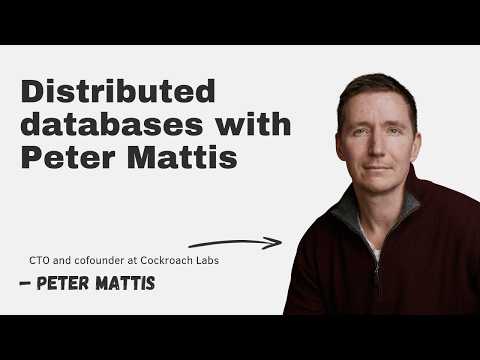
Distributed databases with Peter Mattis

Video thumbnail: Distributed databases with Peter Mattis
Sep 30, 20261h 42m 32s video lengthThe Pragmatic Engineer

The Signal

Peter Mattis, cofounder and CTO of Cockroach Labs, explains how AI has transformed him from a manager into an exceptionally productive hands-on engineer. He argues that AI functions as a force multiplier for experts, enabling faster iteration and higher ambition, provided teams implement rigorous testing, security guardrails, and disciplined human oversight to mitigate model fallibility.

The Case

Career Patterns and Technical Focus

  • Mattis attributes his technical success to a recurring cycle: identifying infrastructure bottlenecks and replacing them with data structures—like B-trees or specialized hash tables—that better align with modern hardware realities.
  • His early work on Gmail and Colossus taught him that large-scale distributed systems often require bootstrapping workarounds, such as the circular dependency between Bigtable and Colossus that necessitated a foundational, non-dependent Bigtable to start.23:11
  • He highlights that distributed databases like CockroachDB exist to absorb the complexity of sharding, replication, and strong consistency, allowing application developers to avoid the pitfalls of manual data partitioning.51:50

AI-Era Workflow and Productivity

  • Since late 2025, Mattis has shifted to a multi-model, multi-session workflow where he occasionally manages 20 to 100 subagents simultaneously, an approach he believes is only effectively managed via modern desktop coding applications.81:06
  • He claims AI-enabled throughput allows him to implement complex features—such as 10,000 lines of optimized Rust—in roughly 30 minutes, a speed that forces him to raise his baseline expectations for system ambition and quality.72:51
  • Mattis asserts that while AI is encyclopedic and fast, it can be lazy regarding testing, which he mitigates through advanced techniques like property-based, metamorphic, and deterministic simulation testing.1:22

Distributed System Principles

  • Strong consistency is presented as a baseline requirement for mission-critical workloads like banking and e-commerce, where stale reads from eventual consistency can cause catastrophic business logic errors.55:45
  • The system defaults to three replicas for consensus, allowing customers to scale to five or seven replicas to manage durability against regional outages, albeit at the cost of higher latency due to speed-of-light physical constraints.61:43

The 1 Minute Signal Take

The most significant shift described is the move from human-led, line-by-line coding to an orchestration model where domain experts act as architects and testers for AI-generated output. For organizations, this implies that the bottleneck has moved from raw developer output to the sophistication of their automated validation and security guardrails.

Pro Analysis

Why It Matters

This content is a masterclass in how senior systems thinkers internalize technological shifts. Mattis provides a rare, tr...
Full analysis always available on Pro.

Time saved:1h 40m 28s

Share this

Tags

Written by: 1 Minute Signal Editorial Team