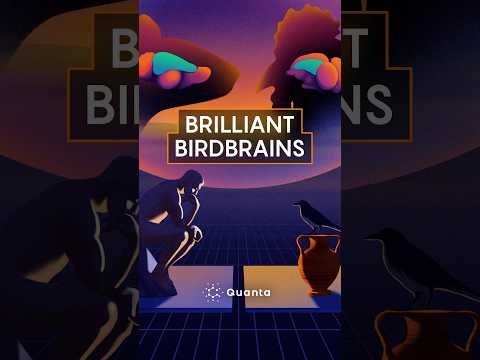
Did Intelligence Evolve Twice?

Video thumbnail: Did Intelligence Evolve Twice?
Oct 1, 20262m 39s video lengthQuanta Magazine

The Signal

Modern science has overturned the long-held assumption that birds are unintelligent because they lack a human-like brain structure. Instead of sharing a common neural architecture with mammals, birds evolved sophisticated cognition independently. This case of convergent evolution relies on distinct brain anatomy, reframing avian intelligence not as a lesser version of our own, but as a separate, highly effective biological solution to complex problem-solving.

The Case

Anatomical Reassessment

  • Birds lack a neocortex—the layered brain structure in mammals historically linked to higher reasoning—which led neuroanatomists to underestimate avian intelligence until the mid-20th century.0:52
  • Research now identifies the dorsal ventricular ridge (DVR) as the seat of bird cognition, a brain region characterized by a neuron density far higher than that found in any mammalian species.1:15

The Evolutionary Evidence

  • A 2025 international collaboration, utilizing molecular techniques, discovered that the bird DVR and the mammalian neocortex originated from entirely different cell types.1:45
  • Birds and mammals last shared a common ancestor roughly 320 million years ago, indicating that their respective paths to high-level intelligence are the result of separate evolutionary trajectories.

Convergent Evolution

  • The phenomenon of "convergence of intelligence" mirrors other biological patterns, such as the independent development of camera-like eyes in both octopuses and mammals, or wings in birds and bats.2:07
  • While some researchers suggest bird cognition on certain tasks is comparable to that of a seven-year-old child, this remains a broad, task-dependent generalization lacking granular support in the current findings.0:34

The 1 Minute Signal Take

The takeaway is that intelligence is not a linear advancement tethered to a single brain structure, but a modular outcome evolution can reach via multiple routes. You should treat specific comparative claims about avian mental "age" as rhetorical shorthand, while regarding the structural independence of bird brains as a settled, significant scientific development.

Pro Analysis

Why It Matters

This research fundamentally reshapes our understanding of the 'uniqueness' of human intelligence. By proving that high-level cognition can emerge from radically different biological architectures, it democratizes our view of consciousness and suggests that cognitive capability is an inevitable byproduct of complex evolutionary pressure, rather than a singular biological accident.

Strategic Implications

This finding pushes the field of comparative neuroscience away from mapping all intelligence onto a mammalian-centric model. It suggests that if we ever encounter alien intelligence or attempt to build synthetic minds, we should not limit our expectations to human-like (neocortex-based) architectures.

Evidence & Hype Audit

  • Strengths: The mention of 2025 molecular data and published papers in Science provides a solid factual anchor.
  • Weaknesses: The '7-year-old child' benchmark is highly subjective and lacks rigor in this summary. It serves as a rhetorical device rather than a hard clinical measurement.

Counterarguments

Critics might argue that even if the architectures are different, the functions of intelligence might still be qualitatively different. Convergent evolution leads to functional similarity, but not necessarily identical subjective experiences or problem-solving styles.

Who Should Care

  • Cognitive Scientists: For moving beyond the neocortex as the only unit of analysis.
  • AI Researchers: To consider alternative non-layered or high-density neural configurations for hardware/software design.
  • Evolutionary Biologists: For updating the vertebrate intelligence timeline.

What To Do Next

  • Investigate the specific cellular lineages that differentiate the DVR from the neocortex.
  • Review the 2025 Science papers referenced in the source for methodological details.
  • Differentiate between structural convergence and functional equivalence in animal cognition.
  • Challenge assumptions that human-like intelligence requires a laminar brain structure.

Share this

Tags

Written by: 1 Minute Signal Editorial Team