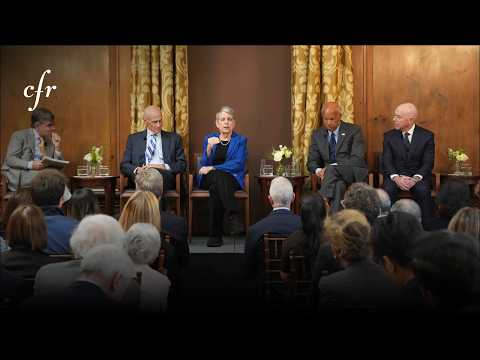
Reflections on 9/11: A Conversation With Former Secretaries of Homeland Security

Video thumbnail: Reflections on 9/11: A Conversation With Former Secretaries of Homeland Security
Sep 11, 20261h 13m 4s video lengthCouncil on Foreign Relations

The Signal

The Department of Homeland Security—created in the shadow of 9/11 to unify national security—faces an institutional identity crisis as its original counterterrorism architecture struggles to contain a modern threat landscape defined by immigration overload, domestic mass violence, cyber-warfare, and AI-driven risks that diverge sharply from the large-scale external jihadist model of 2001.

The Case

Institutional Overload

  • DHS is described by former leaders as being overwhelmed by immigration enforcement, with Janet Napolitano noting that public perception equates the department primarily with ICE at the expense of its broader, critical cyber and disaster-response missions.31:32
  • Jay Johnson, former Secretary of Homeland Security, argues the department is currently ill-equipped to address domestic mass violence, which he labels the nation’s top security threat after observing incidents in Uvalde, Buffalo, and a Chicago suburb.24:59

Strategic Divergence

  • The panelists are deeply divided on the path forward: Johnson advocates for a massive consolidation of federal law enforcement agencies into a single cabinet-level department, while Napolitano warns that such a restructuring would create catastrophic jurisdictional, authority, and civil-liberties complications.25:20
  • Regarding FEMA, a sharp debate remains over whether the agency should be made independent to reduce political interference or kept within DHS to ensure operational synergy with the Coast Guard and other critical infrastructure components.44:25

Emerging Doctrine

  • Cyber capabilities have outpaced government doctrine, with Alejandro Mayorkas citing reports of Chinese operations like "Salt Typhoon" and "Volt Typhoon" to illustrate the urgent need for a regulatory framework covering AI data, disclosure, and human decision-making.37:58
  • While officials agree that interagency communication has improved since 9/11, they worry that intense political polarization and a lack of shared crisis memory among younger generations could prevent a unified, effective national mobilization in the event of a future major attack.50:52

The 1 Minute Signal Take

The core issue is not a failure of security, but a failure of institutional design; DHS is forced to manage 21st-century threats like domestic extremism and AI using a post-9/11 administrative structure that is brittle, overloaded, and increasingly politically contentious. The panelists' sharp disagreement on how to reorganize, or whether to reorganize at all, reflects the reality that there is currently no consensus on how the U.S. should balance state-level operational integration against the need for political accountability.

Pro Analysis

Why It Matters

The transition from the 2001 threat landscape to the current environment represents a generational shift in how the U.S. ...
Full analysis always available on Pro.

Time saved:1h 11m 2s

Share this

Tags

Written by: 1 Minute Signal Editorial Team