
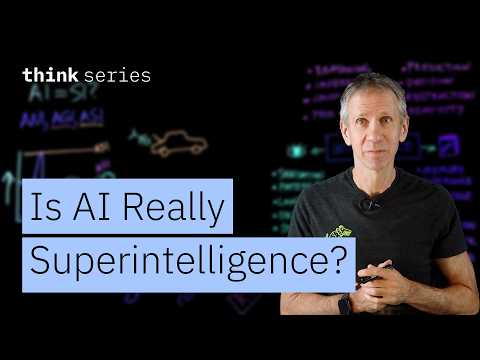
Why It Matters
This synthesis clarifies the high-stakes lexicon of AI safety. By differentiating between ANI, AGI, and ASI, the discourse shifts from vague, alarmist 'AI takeovers' to the technical, measurable gaps in reasoning and reliability that define our current reality.
Strategic Implications
Organizations should pivot from viewing AI as a monolithic threat to treating it as an uneven tool. Strategies should prioritize 'controllability' alongside capability. If an organization cannot effectively halt or interpret a system’s reasoning, it shouldn't be deployed for high-stakes decision-making.
Evidence & Hype Audit
- Strengths: The framework provides a logical, non-hysterical approach to classification.
- Weaknesses: It relies on the speaker's own definitions rather than industry-standard benchmarks. The claims regarding 'control' are aspirational; there is little evidence that a 'kill switch' is effective against truly autonomous, distributed systems.
Counterarguments
Critics might argue that the 'ANI vs. AGI' distinction is increasingly blurred by emergent behavior. If a system solves a novel scientific problem, does it matter if it lacks 'perception' in the human sense? Some argue that control is a fallacy and that safety must be solved through inherent alignment, not reactive mechanisms like kill switches.
Who Should Care
- Policy Makers: To understand that 'AI' is not a singular entity and requires tiered regulation.
- Technical Architects: To emphasize 'observability' and 'abort' protocols in system design.
- Corporate Leadership: To avoid over-relying on current models for mission-critical tasks that require human-level reasoning.
Next Steps
- Conduct a gap analysis of your AI stack: Where do you lack a 'human-in-the-loop' override?
- Establish clear failure-mode benchmarks to identify when a system is hallucinating or underperforming.
- Formalize an internal AI governance framework that defines which tasks require human sign-off.
- Invest in explainability tools to monitor whether your AI is operating within expected parameters.
- Develop incident response plans specifically for 'runaway' or 'uncontrollable' AI behavior.