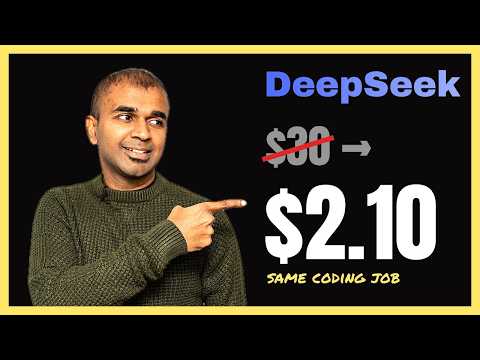
DeepSeek in Claude Code (and the Engine They Gave Away)

Video thumbnail: DeepSeek in Claude Code (and the Engine They Gave Away)
Oct 28, 20268m 21s video lengthMervin Praison

The Signal

DeepSeek has triggered a shift in the AI landscape by releasing its production-grade serving engine, DeepIn, alongside updated model weights. While the lab claims significant benchmark gains, the primary value proposition is economic: providing an ownable, low-cost workhorse for high-volume coding tasks rather than competing as a general-purpose frontier intelligence. The tension here lies between the promise of a cheap, open infrastructure blueprint and the reality that the release remains an incomplete serving stack missing critical operational components.

The Case

The Technical Release

  • DeepSeek released the V4.1 Flash 1017 model under an MIT license on October 17, followed by the DeepIn serving engine under Apache 2.0 on October 20.0:35
  • The DeepIn framework—which includes kernel libraries, expert parallelism, and speculative decoding—is considered the more significant release as it exposes how the lab serves production-scale requests.1:11
  • DeepIn explicitly lacks a KV cache system, prefill/decode disaggregation, and replica load balancing, meaning it serves as an architectural blueprint rather than a turnkey production solution.3:41

Performance and Adoption

  • DeepSeek reports benchmark improvements across Terminal Bench, Program Bench, and DeepSWE, though the source notes these comparisons are rough due to differing lab harnesses and the fact that DeepSeek tested within the Claude Code environment.2:16
  • Users can immediately integrate DeepSeek into Claude Code or Codex workflows via an Anthropic-compatible endpoint, with search and fetch tools provided free of charge until October 31, 2026.4:03
  • DeepSeek is positioned as a cost-efficient alternative for volume work, with specific pricing incentives that double during weekday UK peak hours (1–4 a.m. and 6–10 a.m.).6:04

Operational Reality

  • The release targets high-performance hardware, specifically Nvidia SM100 Blackwell-class GPUs and Huawei Ascend, making it impractical for consumer-grade devices.3:11
  • Self-hosting remains a high-risk endeavor: a recent October 26 postmortem from Cloudflare regarding data leakage during disaggregated serving highlights exactly why the components missing from DeepIn are essential for safety and reliability.7:05

The 1 Minute Signal Take

DeepSeek’s release is a strategic play to commoditize code generation by lowering operational costs and providing transparency into serving architecture. While the model is highly capable for routine agentic workflows, organizations should reserve frontier models for high-stakes refactors and treat DeepIn as a valuable infrastructure reference rather than a drop-in replacement for a managed inference stack.

Pro Analysis

Why It Matters

This release represents the commoditization of the inference layer. By providing both the model and the engine, DeepSeek is lowering the barrier to entry for teams that want the performance of a high-end lab without the total lock-in of a proprietary cloud provider.

Strategic Implications

The shift toward 'harness-based' competition means that the quality of an AI model is increasingly defined by its integration into existing developer workflows (like Claude Code) rather than its raw capability. Teams that master these deployment blueprints will be able to run high-efficiency systems for a fraction of the cost of current frontier alternatives.

Evidence & Hype Audit

  • Trustworthy: The release of DeepIn on GitHub and the provision of an API endpoint are verifiable, high-signal actions.
  • Hype-prone: The speaker’s claim that 'every inference team will read this' is speculative. The benchmark improvements are self-reported and, as the speaker admits, difficult to compare across labs.

Counterarguments

Critics might argue that by releasing an 'incomplete' engine, DeepSeek is merely offloading the complexity of infrastructure maintenance onto the developer, potentially creating more technical debt than it solves. Furthermore, for teams without large-scale Nvidia or Huawei hardware clusters, the technical value of the DeepIn engine is largely theoretical.

Who Should Care

  • Platform Engineers: Those tasked with managing internal model hosting who need performance-tuning blueprints.
  • AI Startup Founders: Those looking to slash inference costs while maintaining control over their model stack.
  • DevOps Professionals: Those building automated coding agents who require deterministic output and high-volume, low-cost throughput.

What to Do Next

  • Analyze your current token spend to identify high-volume routines that can move to cheaper models.
  • Perform a 'compliance audit' on your current API provider versus the option of self-hosting the MIT-licensed DeepSeek Flash weights.
  • Test your agent's performance in the Claude Code endpoint this week while search tools are free.
  • Review the SGLang 0.5.22+ documentation to compare performance patterns against the DeepIn release.
  • Schedule non-urgent batch agent jobs for off-peak hours to capitalize on DeepSeek's pricing tiers.
Time saved:4m 42s

Share this

Tags

Written by: 1 Minute Signal Editorial Team