
Back to Feed
How to understand AI Agents
The Signal
This transcript demystifies the label 'AI agent' by decomposing it into four technical components—model, prompt, context, and tools—all operating within a fifth, critical layer: the agent harness. The creator argues that agents are not magical entities, but compositional systems that require intentional engineering to transition from simple 'vibe-coded' demos to reliable tools for high-consequence deployment.
The Case
- The speaker frames an 'agent' operationally: if a system cannot trigger actions like reading files or querying data, it is merely a text model, not an agent.
- Model choice is presented as the most foundational variable, but the creator warns that benchmarks are less useful than real-world testing because provider, deployment method, and architecture impact performance in ways metrics often miss.
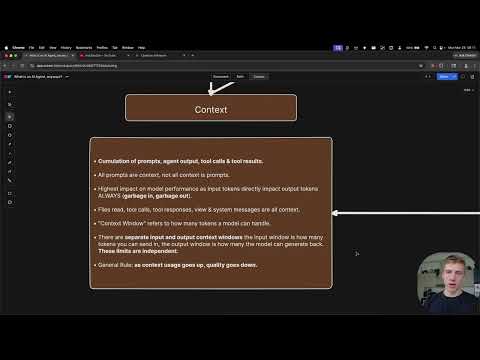
- Context is defined as the agent’s working memory, including every prompt, model output, and tool result; the creator identifies 'context rot' as a primary risk where increasing token volume leads to decreased output quality.
- System prompts are described as high-leverage tools for controlling behavior, citing Claude Code—a developer-focused command-line tool—as an example where the system prompt exceeds 10,000 tokens to enforce constraints.
- The harness—the environment that integrates the other four elements—is labeled as essential, differentiating simple web interfaces like ChatGPT from more agentic configurations like Claude Code; the speaker asserts that better harnesses enable higher agency.
- Several claims remain unsettled or self-serving, such as the assertion that Cerebras is the fastest model provider at 2,500 tokens/sec and the broad, unsupported claim that every modern LLM application functions as an AI agent.
The 1 Minute Signal Take
The breakdown is a practical, engineering-first orientation that cuts through industry hype to reveal the actual machinery of agents. Skip it if you are already familiar with the mechanics of tool calling and context window management, but watch it if you want to understand why your LLM experiments are failing to behave consistently under pressure.
Time saved:
Tags
Back to Feed