
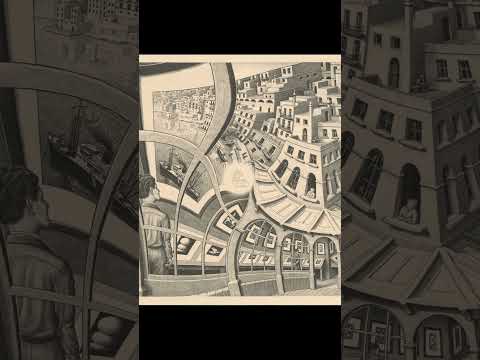
- The central singularity in Print Gallery represents a point where visual scale becomes infinite.
- Logarithmic mapping provides a rigorous way to understand how Escher manipulated perspective to achieve non-Euclidean effects.
- The ambiguity of the center spot is a deliberate byproduct of the recursive loop, functioning as a mathematical 'hole' where the viewer's frame of reference vanishes.
Back to Feed
Escher's most mind-bending piece
This video examines how mathematics, specifically the application of logarithms to visual imagery, reveals the hidden structure within M.C. Escher's lithograph, Print Gallery.
Key Takeaways
- M.C. Escher's Print Gallery utilizes a self-referential loop that creates an apparent visual paradox through recursive composition.
- Applying logarithmic transformations to the image structure resolves the central blank hole by revealing how the perspective is mathematically compressed toward the center.
Talking Points
Analysis
Strategic Significance
Understanding the intersection of classical art and formal geometry is crucial for fields like computer vision and generative graphics. Escher was effectively performing 'manual' spatial transformation, which modern algorithms now interpret as complex coordinate mapping.
Who Should Care
- Computer Vision Researchers: Those interested in image stitching, panoramic mapping, and non-Euclidean projection.
- Digital Artists: Practitioners looking to understand how to build recursive, non-linear compositions.
Contrarian Takeaway
Escher’s 'peculiar' masterpieces were not merely artistic intuition; he was working with advanced algebraic structures long before modern software made such distortions trivial to calculate.
Time saved:
Back to Feed