
Why It Matters
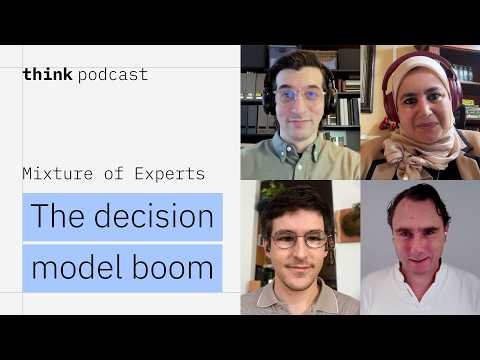
This discussion marks a maturity point in the AI lifecycle where the industry moves from 'magic' to 'systems engineering.' By questioning the value of multi-agent bloat and defining the niche for decision models, it provides a blueprint for building reliable, cost-effective AI software rather than just experimenting with chat interfaces.
Strategic Implications
Organizations should pivot toward 'automation through abstraction.' Instead of manually designing complex multi-agent topologies, teams should favor platforms that handle orchestration automatically. Furthermore, the decoupling of 'decision models' from 'generative models' allows architects to pick the right tool for the job: classification for logic, and autoregressive models for creativity.
Evidence & Hype Audit
The content relies heavily on a cited web-app agent study to provide empirical weight to the multi-agent critique, which adds significantly more value than typical speculative commentary. However, the 'decision model' category is clearly being treated with 'market-speak' optimism; the speakers admit the underlying technology isn't new, revealing that the novelty is purely one of product positioning.
Counterarguments
Critics of the 'single agent' approach might argue that as models become smaller and cheaper, the coordination tax of multi-agent systems will shrink, eventually making parallelized, specialized agent teams the superior architecture for massive-scale automation.
Role-Specific Takeaways
- For Engineers: Stop forcing complex multi-agent workflows; benchmark single-agent performance first.
- For Product Managers: Use decision models for API-level tasks where output reliability is the primary constraint.
- For Safety Teams: Focus on operational fail-safes for embodied AI rather than behavioral policing of user-AI chat logs.
What to Do Next
- Perform a 'coordination tax' audit on current agent workflows.
- Replace chat-based decision logic with dedicated decision models where possible.
- Establish hard physical boundaries for any AI-controlled hardware or lab equipment.
- Conduct a performance baseline test comparing single-agent to multi-agent configurations for your specific task domain.