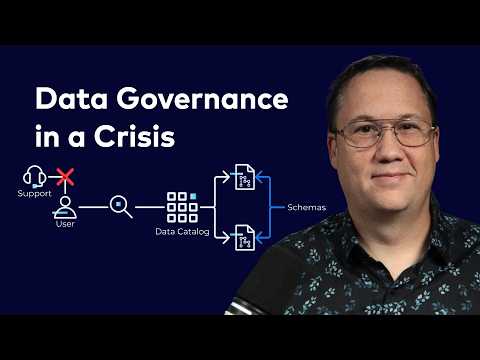
Data Governance in a Crisis: When Every Second Counts

Video thumbnail: Data Governance in a Crisis: When Every Second Counts
Jun 4, 202610m 57s video lengthConfluent Developer

The Signal

Data governance is often treated as an abstract compliance burden, but this case shows why it is operationally critical for incident response. A failed deployment caused production traffic to be rejected as indecipherable "garbage," forcing the on-call team to navigate a high-stakes failure while being blocked from the data by strict security controls. The core tension lies in the balance between least-privilege security that restricts internal inspection and the need for responders to quickly identify the source, owner, and reason for failures when outages strike.

The Case

  • A new fraud-detection microservice in Europe caused payment rejections in Australia because engineers forgot to update a region list in a configuration file, causing decryption logic to fail.8:59
  • Responders diagnosed the issue without direct access to the encrypted data by using schema registry metadata and data lineage to track the transaction flow back to the producing service.5:54
  • The team identified the correct point of contact by finding a listed data steward in the service metadata, a recurring requirement for systems handling regulated information.6:56
  • Least-privilege access rules prevented on-call engineers from inspecting the "garbage" PII (personally identifiable information) directly, forcing them to rely on governance tools instead of raw logs.4:16
  • Governance systems are themselves a risk factor: the transcript warns that catalogs and lineage mappings may update on schedules that lag by up to 24 hours, potentially leading responders to outdated schemas or wrong contacts.9:35
  • While the video uses a fictional Australian regulation to explain the shift to selective encryption, it ties the logic to real-world frameworks like GDPR, which force companies to map data for potential "right to be forgotten" purges.8:01

The 1 Minute Signal Take

This is a useful, low-fluff breakdown of how to design developer-facing governance that actually survives an incident. Watch it if you want an orienting map of how to structure your metadata before the next outage occurs; skip it if you are looking for an interrogation of the 95% re-identification statistic, which the narrator cites as a generic fact without empirical backing.

Pro Analysis

Strategic Significance

  • This illustrates the shift from 'data as a static asset' to 'data as an operational dependency.' When governance becomes part of the CI/CD pipeline, the catalog is not just for compliance—it is an active map for site reliability.

Who Should Care

  • Data engineers, SREs, and Security teams should care because this underscores the friction between security-hardened environments and high-velocity incident response. It is a blueprint for designing 'debuggable' security.

Contrarian Takeaway

  • The most effective 'security' tool during a production outage is actually the metadata catalog, not the firewall. If your security controls are so rigid that they block all observability, you have merely traded a data breach risk for a catastrophic availability risk.
Time saved:8m 36s

Share this

Tags

Written by: 1 Minute Signal Editorial Team