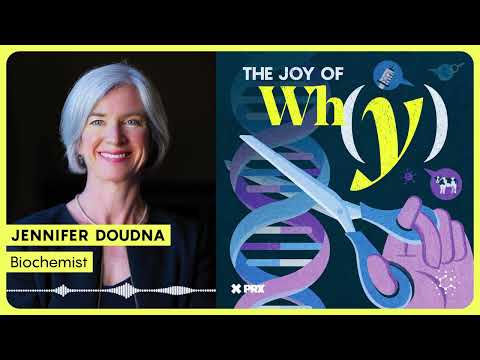
What Is the Future of Gene Editing? | PODCAST: The Joy of Why

Video thumbnail: What Is the Future of Gene Editing? | PODCAST: The Joy of Why
Jun 11, 202649m 41s video lengthQuanta Magazine

The Signal

CRISPR functions as a programmable gene-editing platform because the RNA-guided Cas9 enzyme naturally used by bacteria to destroy viral DNA can be redirected to strike any target sequence. While the mechanism for creating precision DNA breaks is settled, the field remains contested regarding ethical boundaries for germline editing, the long-term feasibility of scaling therapies to non-liver tissues, and speculative theories on the evolutionary origin of life. Jennifer Doudna, a Nobel laureate and UC Berkeley scientist, frames these advancements as a serendipitous byproduct of curiosity-driven RNA research rather than a preplanned engineering effort.

The Case

  • Scientists repurposed an adaptive bacterial defense mechanism where CRISPR loci act as a 'genetic vaccination card,' storing viral fragments to recognize and cut matching DNA sequences using Cas9 as the engine.13:44
  • Baby KJ — a newborn treated in August 2024 for a rare metabolic disease — serves as the first concrete clinical proof-of-concept, achieving treatment via an 8-month turnaround using a delivery system originally developed for COVID-19 vaccines.28:30
  • The distinction between somatic and germline therapy is emphasized, with the 2018 Chinese embryo-editing case condemned by Doudna as an unethical, medically unnecessary experiment that lacked informed consent.38:12
  • Delivery remains the primary bottleneck for wider application; Doudna acknowledges that the liver-targeting success seen in Baby KJ does not translate to muscle, lung, or brain disorders.35:05
  • Genetic editing carries inherent risks, including unintended off-target cuts and the reality that genes often have contextually mixed effects, such as the sickle-cell trait providing malaria protection in specific populations.36:25
  • Doudna admits that while origin-of-life theories like RNA-preceding-DNA have increasing experimental support, they remain fundamentally unverifiable without a 'time machine,' and ideas like panspermia remain speculative.9:48

The 1 Minute Signal Take

This is a rigorous, high-level primer that successfully separates verified therapeutic progress from the speculative hype surrounding climate and germline applications. Watch it if you want to understand the mechanics of CRISPR from a primary source, as the video excels at humanizing the serendipity of the discovery process; skip it if you only need a technical overview of how gene editing works.

Pro Analysis

Strategic Significance:

  • CRISPR represents a fundamental shift in biotech, moving from broad medical interventions to precise, programmable genomic medicine. It decouples the mechanism of cutting from the target location, effectively turning biology into software.

Who Should Care:

  • Clinicians and biotech investors should care as this shifts the landscape from lifelong symptom management to permanent genetic correction. Ethicists and policy makers must engage because the barrier to editing the germline is technical, not just a matter of intent, making regulation difficult to enforce.

Contrarian Takeaway:

  • The most effective way to improve human health through gene editing might not be directly changing human genes, but rather hacking the microbiome of the food systems we depend on—such as engineering cattle-associated microbes to lower methane emissions.
Time saved:47m 17s

Share this

Tags