
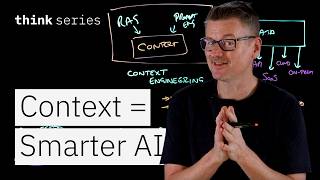

- Basic RAG is insufficient for complex enterprise use cases because it lacks the structural awareness and governance integration required for safe decision-making.
- Context compression is a vital optimization technique; excessive context, regardless of model window size, degrades performance by introducing noise.
- Modern system architecture for AI must prioritize linking data where it lives rather than centralizing it, to maintain state and access control legitimacy.
Channel: IBM Technology
Context Engineering: The New Bottleneck for Enterprise AI
This video argues that model reasoning is no longer the primary constraint for AI performance, proposing instead that 'context engineering' is the critical factor for building useful, governance-aware enterprise applications.
Key Takeaways
- Shift focus from model reasoning to context depth, as current frontier models already have sufficient baseline intelligence for most tasks.
- Infrastructure is the primary hurdle; successful AI integration requires zero-copy data federation that respects existing access controls and governance.
- Replace generic retrieval with purpose-built techniques like agentic, graph-based searching, and compression to maximize signal-to-noise ratios in long-context processing.
Talking Points
Analysis
This is strategically important because it shifts the focus from model-layer optimization (which is largely commoditized) to data-layer engineering. Enterprise leaders often view RAG as a one-time setup, but this analysis correctly identifies it as a dynamic, ongoing architectural responsibility.
Who should care: Software architects and CTOs tasked with making GenAI 'production-grade'.
The Non-Obvious Takeaway: Most developers treat context as a volume problem (giving the LLM more data). This presenter suggests it is a precision problem, where the core innovation is not the quantity of data but the filtering and governance structure enforced before the model ever sees the prompt.
Time saved:
Channel: IBM Technology