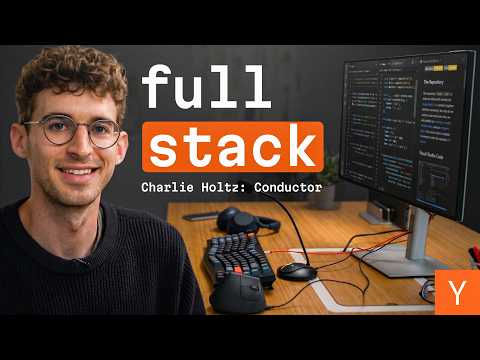
How Conductor CEO Charlie Holtz Sets Up His Team Of AI Agents

Video thumbnail: How Conductor CEO Charlie Holtz Sets Up His Team Of AI Agents
Jun 4, 202616m 35s video lengthY Combinator

The Signal

Conductor is a Mac application designed to orchestrate multiple coding agents through a voice- and keyboard-driven, opinionated workflow. Co-founder Charlie argues that prompt-centric software is the future, treating code as temporary "sawdust" while prioritizing human review and structured PR-based workflows over direct file editing to maintain software craft.

The Case

  • Conductor enforces an indirect coding model where users cannot edit files directly; every task must move through a worktree to a pull request, subsequent human review, and merge, ensuring an audit trail for all AI contributions.9:11
  • Co-founder Charlie claims he rarely writes code himself now, functioning instead as a conductor who delegates tasks, comments on agent output, and merges PRs, while only occasionally making minor manual edits to configuration files.2:40
  • The team mandates human-only "slot free zones" within their codebase where AI can contribute only under strict human review, a design choice Charlie says is necessary to prevent potential AI-driven feedback loops that propagate bad code patterns.5:51
  • Conductor is being optimized for a future of persistent, long-running agent environments beyond current laptop-bound constraints, a strategy that drives the company’s current R&D into cloud workspaces.9:36
  • Charlie’s personal usage intensity is high, including a $22,000 token expenditure in July 2025; he advocates for "token-maxing" and "fast mode" to prioritize model effort over lines-of-code efficiency.12:07
  • The company eschews formal analytics and A/B testing in favor of "conviction-building" through daily dogfooding, a gut-feel approach that Charlie admits may conflict with the configurability some power users demand.10:10

The 1 Minute Signal Take

This is a candid, high-signal look at the realities of heavy agent-assisted development, specifically acknowledging the tension between the founders' opinionated design and the need for user customization. Watch it if you want to see how a high-velocity team actually structures an AI-first workflow; the summary covers the mechanics, but the video provides necessary texture on why they view GUI-based orchestration as superior to terminal-centric tools.

Pro Analysis

Strategic Significance:

  • Conductor demonstrates a shift in the software lifecycle where the primary artifact is the prompt workflow rather than the source code. By enforcing a review-gated PR flow, the platform attempts to solve the 'AI drift' problem—where agents optimize code into incomprehensible or buggy states.

Who Should Care:

  • Startup CTOs and software engineers who want to scale productivity through agent orchestration platforms rather than just individual coding tools.
  • Those building developer tooling who need to navigate the tension between opinionated workflows and user requests for configurability.

Contrarian Takeaway:

  • Higher agent capability might lead to less code, not more. By focusing on 'token-maxing' and fast, small model interactions, developers can reduce codebase bloat, treating the resulting lines of code as disposable 'sawdust' that can be regenerated whenever models improve.
Time saved:14m 17s

Share this

Tags