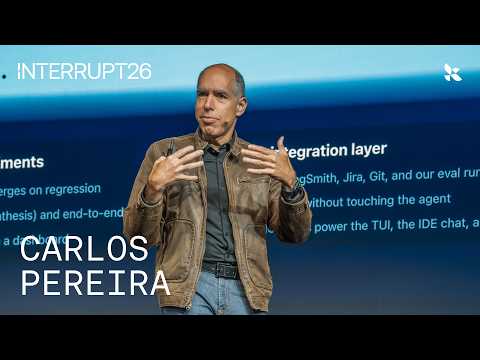
Observing And Testing CX Agents | Interrupt 26

Video thumbnail: Observing And Testing CX Agents | Interrupt 26
Jun 10, 202622m 41s video lengthLangChain

The Signal

Cisco's customer experience organization, which manages roughly 16 million annual support interactions, has moved from reliance on manual ticket queues to a production-grade agentic workflow. The core tension lies in maintaining human accountability for fixes while automating the high-volume triage of production feedback—a challenge they address by treating observability as infrastructure.

The Case

Architectural Loop

  • Production signals including thumbs-downs, errors, and traces are captured via LangSmith and fed into an AI-assisted loop that performs triage, diagnosis, and clustering.6:02
  • The system automatically drafts potential fixes and opens Jira issues through an MCP-based integration, allowing an agent to operate without manual queue intervention.
  • Cisco enforces a strict separation of concerns for agent roles: AI agents are empowered to read, cluster, and suggest fixes, but human experts must approve all write-stage actions and pull request merges.7:24

Observability and Evals

  • The team treats model evaluations as core code infrastructure rather than side experiments, keeping them versioned inside the repo with both component and end-to-end coverage.11:53
  • Observability is treated as a potential bottleneck, leading the team to instrument their own monitoring stack with Splunk to maintain visibility into up to 153,000 concurrent requests.21:59
  • By using MCP as an integration layer, the company maintains a decoupled architecture where backend agent tools can be swapped out without requiring front-end changes.12:44

Semantic Routing

  • For high-ambiguity enterprise customer requests, the system employs semantic routing that combines real-time environment data, historical case patterns, and specialized agent expertise.19:30
  • Guardrails are applied to routing prompts specifically to filter out profanity or emotional bias often generated during network outages.20:12

The 1 Minute Signal Take

The transition from chatbot demos to production-agentic workflows relies on the disciplined treatment of evals as mission-critical regression testing. Cisco's framework suggests that scaling support doesn't mean removing humans, but rather restricting their involvement to high-leverage decision points while automating the high-volume noise of production triage.

Pro Analysis

Why It Matters

This talk represents the 'second wave' of enterprise LLM adoption: moving from conversational interfaces to reliable agentic workflows. By integrating AI into the software development lifecycle (SDLC) rather than just the customer-facing chat field, Cisco demonstrates how to solve the scaling crisis inherent in high-volume support environments.

Strategic Implications

Cisco is essentially turning their customer support floor into a continuous integration engine. This shifts the value of a support interaction: it no longer terminates at the deflection of a ticket, but compounds as part of a permanent, automated regression-testing suite. This creates a cumulative competitive advantage where the product gets better precisely because it had customers.

Evidence & Hype Audit

  • Strengths: The architectural description of MCP usage, separation of concerns, and the 'humans on writes' policy is highly detailed and structurally sound.
  • Weaknesses: Claims like '95-plus percent accuracy' are presented as assertions without benchmark data. The causality between their agentic implementation and the reduction in ticket volume (1.6M to 1.4M) is presented as a correlation rather than a proven result of the system.

Counterarguments

Critics might argue that such a rigid, high-discipline infrastructure (versioning datasets in-repo, strict MCP decoupling) creates an excessive administrative tax that only a company of Cisco's size can afford to pay. Smaller or more agile teams might find this 'enterprise-heavy' approach stifling to iteration speed.

Who Should Care

  • Engineering Leads: For the patterns on versioning evals as infrastructure.
  • Product Managers: For the philosophy of treating user negative feedback as binary signals for code changes.
  • DevOps/SRE: For the 'observe the observer' mentality regarding AI observability stacks.

What to Do Next

  • Audit existing feedback channels; count how many 'thumbs-down' signals currently result in a Jira ticket.
  • Verify if your evaluation datasets are tied to production code versioning or if they are decoupled/isolated.
  • Implement a 'write-approval' role in your agentic workflows to define where AI autonomy ends.
  • Choose one high-frequency support route and test an MCP-based agentic pipeline to handle it.
  • Setup a dedicated monitoring dashboard for your LLM observability tool (like LangSmith) to catch infrastructure latency.
Time saved:19m 15s

Share this

Tags

Written by: 1 Minute Signal Editorial Team