
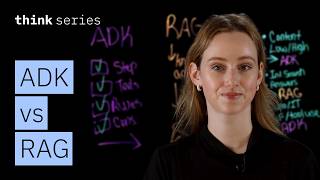

- ADK architectures focus on multi-step reasoning, tool interactions, and operational triage.
- RAG architectures are optimized for large-scale document lookup and minimizing hallucinations through external grounding.
- Successful enterprise implementations often function as hybrid systems where an agentic layer performs logic over retrieved context.
Back to Feed
Choosing Between AI Agent Frameworks and Retrieval Systems
This video outlines a foundational framework for selecting the right AI architecture by distinguishing between agent-based task execution and document-grounded retrieval systems.
Key Takeaways
- Agent development kits (ADK) are designed for procedural reasoning, tool calling, and executing multi-step business logic.
- Retrieval augmented generation (RAG) is essential for grounding responses in specific, high-volume, or dynamic knowledge sources.
- Most enterprise-grade AI solutions function best as hybrids, utilizing agents for orchestration while surfacing real-time facts via RAG.
Talking Points
Analysis
Strategic Importance
This mental model addresses one of the most common pitfalls in AI development: over-relying on LLMs for reasoning when the application actually requires reliable retrieval, or vice versa. Most developers focus too heavily on the model's 'intelligence' rather than the architecture's 'structure'.
Who Should Care
Technical architects and product managers building AI-integrated workflows will find this framing highly actionable for reducing system fragility.
The Non-Obvious Takeaway
Standard 'chat' interfaces often mask the failure to choose an architecture. The highest-performing systems are not conversational wrappers; they are hardened pipelines that explicitly separate task execution flow from evidence retrieval, treating the LLM merely as a participant in both.
Time saved:
Back to Feed