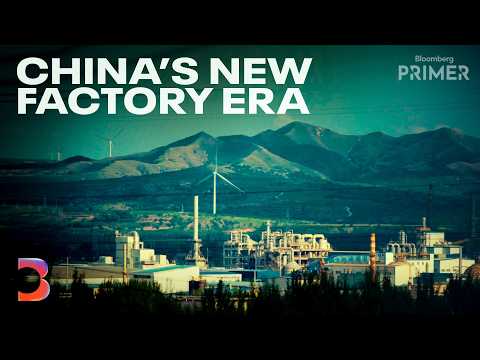
The Technology Transforming China’s Factories | Bloomberg Primer

Video thumbnail: The Technology Transforming China’s Factories | Bloomberg Primer
Nov 16, 202610m 47s video lengthBloomberg Originals

The Signal

China is moving to decarbonize its massive, coal-dependent manufacturing base by transforming industrial parks into centralized, renewable-powered "zero-carbon" clusters. This strategic pivot, codified by a March 2026 government target to designate 100 such parks within five years, attempts to turn industrial policy into an exportable laboratory for future global decarbonization technologies.

The Case

Scaling the Model

  • China’s industrial economy is concentrated in zones that account for 80% of its factories and roughly 50% of its GDP; the government aims to establish 100 zero-carbon industrial parks by 2031 to address the nation’s status as a top global carbon emitter.0:17
  • While "zero-carbon" often refers to a 90% green energy portfolio rather than literal zero emissions, private companies like Envision — a massive global clean energy manufacturer — have begun operating experimental off-grid sites that achieve 100% renewable power.5:00

The Operational Challenge

  • The primary technical hurdle is intermittency: because these sites operate off-grid, they must pair wind and solar with sophisticated battery storage, fast-ramping electrolyzers, and AI-driven weather forecasting models to maintain a stable power supply for industrial processes.7:02
  • Envision’s Chifeng plant in Inner Mongolia demonstrates the production of green ammonia — a feedstock created by combining green hydrogen with nitrogen — which may eventually serve as both a salable product and a backup power carrier for the plant itself.6:12

Economic and Sectoral Realities

  • The feasibility of this model varies by sector; light manufacturing like textiles or electronics can transition to green electricity relatively easily, whereas heavy industries like steel and cement require deeper technological overhauls.8:41
  • Currently, the market for green hydrogen and ammonia remains small and relies on government subsidies to close the price gap with conventional, fossil-fuel-derived alternatives.8:09

The 1 Minute Signal Take

The move toward zero-carbon industrial parks represents a high-stakes bet that centralized infrastructure can overcome the intermittency of renewable energy at an industrial scale. While the model is currently a capital-intensive laboratory for a few elite firms, China’s ability to standardize these parks will determine whether this becomes a viable template for the rest of its industrial economy.

Pro Analysis

Why It Matters

This development represents the industrialization of climate policy. By folding decarbonization into the very architecture of its manufacturing clusters, China is attempting to bypass the slow, expensive process of retrofitting an entire national grid. This shifts the challenge from a broad systemic overhaul to a modular, replicable infrastructure project.

Strategic Implications

If successful, this model allows China to export not just products, but entire standardized industrial systems. The 'Zero-Carbon Industrial Park' could become a plug-and-play exportable commodity, allowing developing nations to adopt Chinese energy solutions that serve both economic growth and climate goals simultaneously.

Evidence & Hype Audit

  • Evidence: The existence of the Chifeng plant is well-documented and demonstrates the viability of the technological components.
  • Hype: The prediction that China will lead the global export of these technologies is speculative. It assumes that these localized, high-capital experiments will translate into cost-effective and globally desirable systems that other nations will willingly adopt.

Counterarguments

Critics might argue that these projects remain 'lab-grown' successes—heavily subsidized, niche, and geographically favored by regions with massive renewable potential. Attempting to scale this across provinces with less optimal wind/solar resources could lead to massive capital inefficiency and economic drag.

Who Should Care

  • Investors: Keep an eye on companies specializing in hydrogen electrolysis and AI-integrated grid management.
  • Policy Makers: Look at how China structures these subsidies as a blueprint for domestic industrial intervention.
  • Manufacturing Executives: Assess if the 'park-level' approach is viable in your specific region to lower carbon footprints without relying solely on unstable public grids.

What To Do Next

  • Conduct a gap analysis between current energy-intensive processes and potential green hydrogen alternatives.
  • Track the 2031 deadline for the 100-park goal to see if adoption accelerates or hits a regulatory ceiling.
  • Monitor the price convergence of green ammonia versus conventional alternatives in global trade markets.
  • Investigate whether similar cluster-based strategies are being proposed in domestic jurisdictions outside of China.
Time saved:7m 21s

Share this

Tags

Written by: 1 Minute Signal Editorial Team