
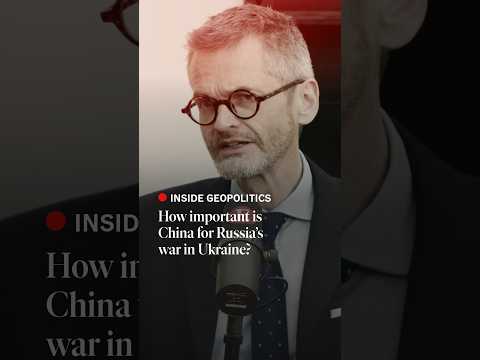
Why It Matters
This analysis highlights the transformation of the Russia-China relationship from a political convenience to an existential necessity for the Kremlin. The shift is not merely regional; it creates a feedback loop where Western sanctions against Russia serve to inadvertently accelerate the integration of China’s military-industrial complex with its foreign counterparts, providing Beijing with invaluable field data that would otherwise be impossible to obtain.
Strategic Implications
The central implication is that China has secured a 'strategic veto' over Russia’s military capacity. By controlling the supply of essential war goods, Beijing can effectively modulate the intensity of the conflict without ever putting its own soldiers in harm's way. For the US and its allies, this suggests that isolating Russia is increasingly difficult without effectively addressing the Chinese economic pipeline.
Evidence & Hype Audit
The content relies heavily on expert assertion rather than granular evidentiary support. Claims regarding the 'inability' of the Russian economy to function without China are strong and arguably overconfident given the complexities of global black markets and sanctions evasion. The prospect of a postwar Russian 'tilt' toward the West should be treated as speculative geopolitical forecasting rather than a high-probability outcome.
Counterarguments
One could argue that Russia’s dependency might actually lead to a complete absorption rather than a 'movement apart.' If the Russian state becomes sufficiently hollowed out, the incentive to pivot to the West may disappear, replaced by an inability to do so. Furthermore, Russia may find that the West is unwilling to accept it back into the fold, regardless of its desire to realign.
Who Should Care
- Defense Strategists: Focus on the intelligence leakages inherent in current drone deployment.
- Trade Policy Analysts: Monitor how dual-use goods are traversing the Russian border.
- Investors: Account for the long-term risk of a bifurcated global economy centered on these two primary blocs.
What to Do Next
- Map the critical bottlenecks in the Russian drone production cycle.
- Track the frequency and volume of sanctioned goods transiting through third-party nations.
- Analyze the rhetoric of Russian officials concerning the 'long-term stability' of the China-Russia axis.
- Compare the current Russian-Chinese technological transfer to historical precedents.