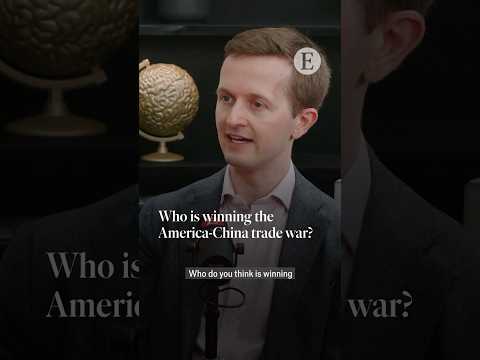
Who is winning the America-China trade war? | The Economist

Video thumbnail: Who is winning the America-China trade war? | The Economist
May 10, 20262m 8s video lengthThe Economist

The Signal

China currently holds a significant strategic advantage in the ongoing trade confrontation with the U.S., driven largely by its control over rare-earth mineral refining. While both nations possess coercive tools like tariffs and sanctions, the central tension lies in whether this situation constitutes a volatile truce or a hardened stalemate where China, by leveraging asymmetric supply dependencies, is actively driving the agenda. The narrator posits that the U.S. appears increasingly cautious in its policy responses due to this vulnerability.

The Case

  • China maintains a dominant chokehold on the refining of critical minerals, which are essential for high-tech components including brushless motors for drones and F-35 jet engines.0:31
  • The narrator links this leverage to a 2020 strategy outlined by Xi Jinping, who explicitly sought to cultivate asymmetric dependencies where the global economy is more reliant on China than vice-versa.0:50
  • While the U.S. retains significant retaliatory instruments—specifically tariffs, financial sanctions, and broad technological restrictions—the speaker argues these have proven less decisive in the current phase of the dispute.1:26
  • Evidence of an active power play is cited from the past week, during which Beijing reportedly instructed Chinese firms to ignore specific U.S. sanctions targeting companies doing business with Iran.1:43
  • The claim that the Trump administration has been 'cowed' by these export controls remains an interpretive assertion by the speaker and is not supported by documented policy outcomes within the transcript.

The 1 Minute Signal Take

The video offers a coherent framework for viewing trade as a struggle over supply-chain leverage rather than just tariff levels, but it frequently tips from insightful analysis into speculative interpretation. Skip this; the summary captures the strategic core, while the video provides little additional hard data to substantiate its claims about the specific internal drivers of the current U.S. caution.

Pro Analysis

Strategic Significance:

  • This highlights the vulnerability of the global tech supply chain to extreme regional concentration of refining capacity. It confirms that raw material control can effectively neutralize traditional financial and technological warfare.

Who Should Care:

  • Defense contractors, semiconductor manufacturers, and geopolitical analysts should be concerned. Exposure to Chinese-refined critical minerals is no longer just a supply-chain headache; it is a primary vector for foreign policy coercion.

Contrarian Takeaway:

  • Financial sanctions might be losing their efficacy as the primary tool of U.S. leverage. By forcing companies to choose between complying with U.S. directives or maintaining access to the Chinese supply chain, Beijing is effectively turning the cost of compliance into an existential threat for certain industries.
Time saved:1s

Share this

Written by: 1 Minute Signal Editorial Team