Side Effects May Include Dependency on China | Why It Matters

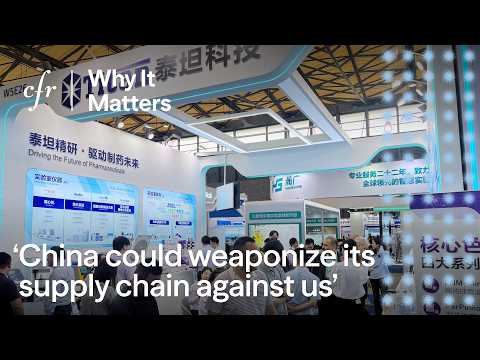
Video thumbnail: Side Effects May Include Dependency on China | Why It Matters
Oct 15, 202629m 35s video lengthCouncil on Foreign Relations

The Signal

The U.S. pharmaceutical supply chain is suffering from a deep, systemic dependency on China that extends far beyond finished medication. By controlling upstream inputs and key starting materials, China holds potential choke points that could paralyze American medicine production. The central tension pits the historical U.S. priority for low-cost procurement against an urgent need for industrial resilience.

The Case

Upstream Vulnerabilities

  • China is embedded in the production of critical medicines, including ibuprofen, acetaminophen, and antibiotics, often through sole-source control of key starting materials.0:41
  • Reliance is recursive and hidden: the U.S. may source active pharmaceutical ingredients (APIs) from India, while India itself remains dependent on raw precursors manufactured in China.4:09
  • Experts allege that 700 specific drugs depend on single-source Chinese inputs, meaning a disruption would leave manufacturers unable to produce these essential treatments.1:54

Biologics and Industrial Policy

  • Biologics—complex drugs grown in living cells—present a new, stickier form of dependency because FDA site validation effectively locks production into specific, often Chinese-based, facilities for years.14:50
  • The current dependence is an intentional outcome of U.S. industrial policy that favored low prices over domestic capacity, leading to the closure of critical plants like the last U.S. penicillin facility in 2004.6:57
  • Rare-earth minerals serve as a grim precedent; China has already weaponized those supply chains against Japan and other Western nations, suggesting pharma coercion is a credible future risk rather than a hypothetical.4:30

The Innovation Squeeze

  • U.S. biotech capacity is simultaneously being eroded by federal funding volatility, including the freezing of $2.3 billion in NIH grants and the loss of 25,000 research personnel from federal agencies.21:18
  • Proposed solutions emphasize "allied scale," which involves diversifying supply across partners like India, South Korea, and Europe, rather than attempting full domestic reshoring, which would significantly raise consumer prices.18:24

The 1 Minute Signal Take

The U.S. pharmaceutical base is functionally brittle, as China’s control over chemical precursors gives it leverage that cannot be solved by simply importing finished pills from different countries. Solving this requires both the difficult political work of subsidizing more expensive domestic manufacturing and a coordinated strategy with allies to decouple the upstream supply stack.

Pro Analysis

Why It Matters

The pharmaceutical supply chain represents the ultimate 'invisible' infrastructure. Unlike semiconductors or energy, medi...
Full analysis always available on Pro.

Time saved:27m 40s

Share this

Tags

Written by: 1 Minute Signal Editorial Team