
Channel: Bloomberg Originals
Why China Is Building the World’s First $2 Trillion Megacity
The Signal
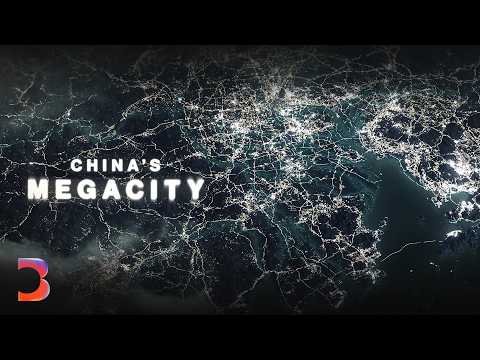
China is pivoting its national growth strategy from individual-city development to the engineering of mega-regional clusters—most notably the Greater Bay Area, an 11-city zone housing 86 million people. The central tension pits state-led attempts to jump-start productivity against the preservation of traditional local communities and wildlife. While proponents view this integration as a necessary escape from the middle-income trap, the practical reality remains contested due to deep institutional, legal, and political divides between mainland China and Hong Kong.
The Case
- To overcome an economic slowdown, China's latest five-year plan mandates a transition to 19 massive urban clusters designed to concentrate labor and innovation, aiming to boost productivity from middle to high-income levels within a decade.
- The Northern Metropolis—a major multi-billion-dollar infrastructure project in northern Hong Kong—is being built to physically bridge the gap to mainland China, intending to transform rural farmlands and fish ponds into a tech hub.
- Local political resistance to such development, once common in Hong Kong, has been effectively neutralized following the imposition of the national security law and the subsequent crackdown on mass democracy protests.
- Shenzhen, a planned megacity that exploded from a projected 1 million residents in 2000 to an actual 18 million today, serves as the primary, high-salience proof-of-concept for the regime’s urban-engineering model.
- Genuine economic and social integration remains unsettled, as the Greater Bay Area attempts to fuse divergent political systems, currencies, tax regimes, and legal frameworks across a border that physically separates Hong Kong and Macau from the mainland.
- The narrator and official project messaging present this integration as a 'utopian' growth necessity, but these claims are unsupported by an independent audit, and critics highlight the irreversible loss of local village life and biodiversity as an unacknowledged cost.
The 1 Minute Signal Take
The video offers a coherent, macro-level look at China's urbanization strategy, though it relies heavily on the state's own rationales for why such forced concentration is necessary. It succeeds in illustrating the structural, rather than just physical, barriers to economic fusion. Watch it for the clear breakdown of the 'Greater Bay' vision and how it contrasts with the personal cost to local residents, but skip it if you are looking for a rigorous critique of the long-term economic viability of these artificial megaregions.
Time saved:
Channel: Bloomberg Originals