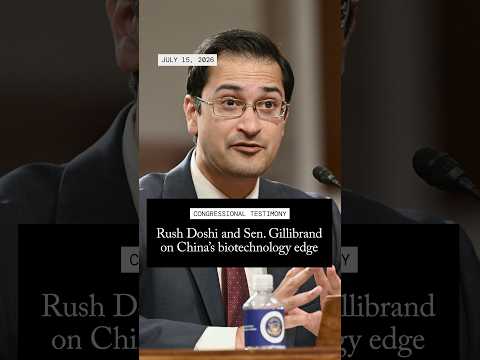
Rush Doshi and Sen. Gillibrand on China’s biotechnology edge

Video thumbnail: Rush Doshi and Sen. Gillibrand on China’s biotechnology edge
Jul 29, 20261m 35s video lengthCouncil on Foreign Relations

The Signal

China holds a critical biotech edge through large-scale, low-cost biomanufacturing and a streamlined ethics-board pathway that can authorize early human testing nearly a year faster than the U.S. FDA. This combination creates a competitive cycle where Chinese assets offer more de-risked data, forcing U.S. stakeholders to negotiate a high-stakes trade-off between speed, safety, and long-term industrial independence.

The Case

Competitive Advantages

  • China builds and operates biomanufacturing capacity at a mass scale that results in costs significantly lower than in the U.S., with some pricing falling below actual production levels.0:11
  • The Chinese clinical trial process allows researchers to bypass standard FDA-equivalent delays by clearing ethics-board hurdles at hospitals, a speed advantage estimated at up to one year.0:29
  • U.S. pharmaceutical buyers frequently pay a premium for Chinese-developed biological assets because the rapid development process provides high-quality, de-risked data that reduces uncertainty for the acquirer.0:46

Strategic Consequences

  • The cumulative effect of these advantages is described by the speaker as a hollowing out of U.S. drug discovery and a shift of critical biomanufacturing infrastructure away from the United States.
  • While the legislative framework known as Biosecure has begun to reduce U.S. reliance on Chinese providers, those efforts remain incomplete and insufficient to counteract the current economic gap.

Proposed Response

  • To address this, the speaker recommends a three-pronged U.S. strategy: aggressively reforming the FDA’s clinical trial processes, incentivizing domestic biomanufacturing investment, and systematically reducing dependence on offshored supply chains.1:13

The 1 Minute Signal Take

The core issue is that U.S. regulatory and manufacturing bottlenecks are being monetized by Chinese competitors who produce more marketable, data-rich assets at a lower cost. Policy reform must address the discrepancy in trial speed as decisively as it addresses industrial subsidies, or the U.S. risks losing its foundational advantage in drug development.

Pro Analysis

Strategic Implications

This situation represents a classic 'regulatory arbitrage' problem. By maintaining a more flexible, albeit potentially less rigorous, early-stage testing environment, China has created a superior pipeline for generating the data that VCs and Big Pharma crave. The strategy effectively turns China into the global R&D laboratory for the next generation of biologics.

Evidence & Hype Audit

  • Strengths: The mechanism described (ethics-board vs. FDA speed) is logically sound and aligns with known procedural differences between the two nations' health systems.
  • Weaknesses: The 'below cost' claim is a significant assertion that lacks proof. It is unclear if this is due to deliberate state subsidies, economies of scale, or mere rhetoric. Furthermore, the 'hollowing out' narrative is a structural conclusion that lacks specific displacement data; it remains a warning rather than a confirmed trend.

Counterarguments

Critics might argue that the speed advantage in China comes with hidden costs: lower data quality or greater risks to patient rights, which may eventually lead to higher costs in later-stage trials or regulatory hurdles during global product registration. Additionally, the U.S. focus on safety and rigorous validation serves as a global gold standard that inherently prevents the 'rushed' failures seen in less regulated systems.

Who Should Care

  • Biotech Investors: Must weigh the premium paid for 'de-risked' data against the long-term geopolitical risk of supply chain decoupling.
  • Policy Makers: Should focus on the process of FDA approvals to determine if there are safe ways to accelerate the timeline without compromising ethics.
  • Pharma Executives: Need to diversify supply chains to avoid future shocks from further Biosecure-style interventions.

What To Do Next

  • Conduct a granular audit of current R&D pipelines to identify dependency on Chinese clinical data.
  • Lobby for legislative packages that explicitly tie drug manufacturing subsidies to domestic job creation.
  • Establish internal compliance committees to prepare for potential future expansion of the Biosecure bill, which may ban specific Chinese CDMOs (Contract Development and Manufacturing Organizations).
  • Assess whether current clinical trial protocols in the U.S. contain legacy administrative friction that can be removed without lowering clinical quality.

Share this

Written by: 1 Minute Signal Editorial Team