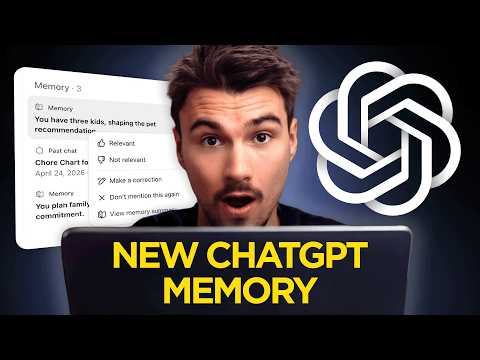
ChatGPT's Memory Update Explained & More AI News You Can Use

Video thumbnail: ChatGPT's Memory Update Explained & More AI News You Can Use
Jun 5, 202615m 3s video lengthThe AI Advantage

The Signal

OpenAI is transitioning ChatGPT from a conversational interface to an action-oriented agent platform by integrating Codex coding capabilities and Atlas browser-automation tools directly into the app. Simultaneously, the company has overhauled its memory system from simple extracted snippets to a structured, editable report-style profile that persists across chats. This shift highlights a broader industry trend where major platforms are competing to integrate persistent context management and creative-to-action workflows, though rollout timelines remain speculative.

The Case

  • ChatGPT now features a centralized memory management UI where users can audit, edit, or delete persistent entries, moving away from the previous model of opaque, automated snippet extraction.2:26
  • OpenAI announced plans to merge Codex — a tool currently used for file creation and plugin-based workflows — and Atlas browser-automation features into the main ChatGPT application, effectively centralizing agentic capabilities.8:21
  • A new 'sites' feature for enterprise-level app prototyping is currently locked behind a business-plan pricing gate, requiring at least two users at a $25-per-seat monthly commitment for one year.12:52
  • Beyond OpenAI, YouTube is testing US-based AI features for homepage personalization and cross-video answer synthesis, while Nvidia announced AI-specific PC chips arriving this fall for major OEMs including Dell, HP, and Microsoft Surface.13:35
  • The speaker’s comparative assessment that ChatGPT currently lags behind Claude in memory comprehensiveness and chronological detail is based on his own testing, not corroborated by independent data.4:54
  • Whether standalone apps like Codex or Atlas will be phased out post-integration is currently unknown, with OpenAI yet to clarify its long-term product roadmap for these tools.9:18

The 1 Minute Signal Take

The video is worth watching primarily for the live demonstration of the creative-production plugin workflow, which effectively illustrates how agentic tools can bridge the gap between prompt generation and external design software like Canva and Figma. While the speaker provides a useful walkthrough of the new memory UI, his comparative ranking between ChatGPT and Claude is subjective and prone to his specific usage patterns. Skip the marketing fluff regarding his personal courses, as the technical product updates captured here are the true substance.

Pro Analysis

Strategic Significance:

This represents a pivot from 'chat-as-a-service' to 'agent-as-a-platform'. By centralizing memory and action-taking capabilities (Codex/Atlas), OpenAI is attempting to increase the 'stickiness' of ChatGPT, making it difficult for users to switch to competitors who might own the context but not the action-layer.

Who Should Care:

Power users and business professionals who rely on AI for productivity will see significant workflow changes. Frontend developers and tool makers should care as ChatGPT begins to automate the 'last mile' of creative and data production, potentially reducing dependence on standalone web plugins.

Contrarian Takeaway:

Merging agentic apps into a single platform often creates a 'feature bloat' nightmare. While it simplifies the product for the generalist, it may sacrifice the speed and specialized utility that power users previously found in lighter, standalone tools like the original Codex.

Time saved:12m 37s

Share this

Tags

Written by: 1 Minute Signal Editorial Team