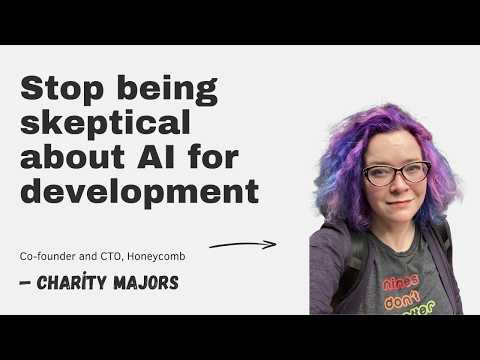
Stop being skeptical about AI for development with Charity Majors

Video thumbnail: Stop being skeptical about AI for development with Charity Majors
Aug 12, 20261h 26m 23s video lengthThe Pragmatic Engineer

The Signal

AI is no longer an abstract future goal but a present operational friction, creating a rift between enthusiasts who prioritize speed and operators who shoulder the resulting reliability costs. This tension stems from a broken feedback loop: AI-generated code is being shipped without the manual scrutiny that historically caught bugs, necessitating a shift toward robust, automated validation systems.

The Case

The Reliability Fracture

  • The industry is split between AI enthusiasts—who gain from rewrites and toil reduction—and on-call operators who see degraded reliability and rising incident counts.0:09
  • Reliability strain is documented in real-world examples like Meta’s flurry of "Sev Zero" outages and Intercom/Finn’s 18-month struggle with code quality after adopting AI; these are not merely ideological disputes but vantage-point differences.40:05
  • AI introduces nondeterminism into software, requiring more engineering discipline, not less; the core issue is trust debt, as AI output consumes human trust faster than current validation habits can replenish it.26:56

Operational Realignment

  • Charity Majors—a co-founder of the observability firm Honeycomb—argues that production is not what happens after development but a vital stage of it, requiring telemetry that is integrated into the development loop.21:03
  • Traditional logs and metrics are insufficient for modern multi-agent systems; engineers need richer "timeline" primitives that capture relationships and context across hours-long interactions.59:05
  • Software economics are shifting toward a "replace-don't-fix" model, where AI generates variants faster than human reading can parse, making deterministic conformance tests and behavioral evals the necessary trust substrate.13:48

Leadership and Career

  • Career survival now depends on active AI literacy; directors and managers should remain hands-on, or return to individual contributor work if necessary to regain technical credibility.70:42
  • Sending unread AI-generated content is a breach of professional respect, as it externalizes cognitive labor onto the recipient; leaders must prioritize business competence to maintain cultural influence.34:55

The 1 Minute Signal Take

The most critical takeaway is to stop treating production as a separate environment and start treating it as the primary feedback loop for AI-generated output. You must replace manual, low-value code reviews with automated validation harnesses, while ensuring your leadership remains hands-on enough to maintain business-level sensemaking.

Pro Analysis

Why It Matters

This content serves as a critical bridge between the hype cycle of AI and the harsh reality of production software enginee...
Full analysis always available on Pro.

Time saved:1h 24m 27s

Share this

Tags

Written by: 1 Minute Signal Editorial Team