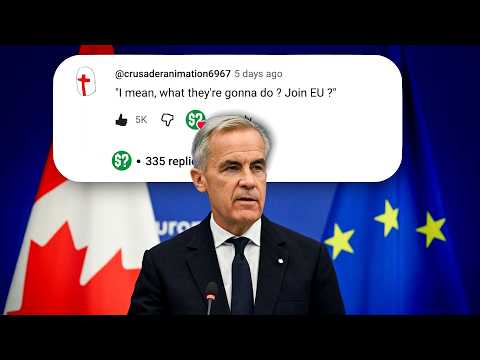
Canada Is Joining The EU... But WTF Does That Even Mean?!

Video thumbnail: Canada Is Joining The EU... But WTF Does That Even Mean?!
Sep 24, 202616m 59s video lengthHow Money Works

The Signal

Canada has been invited to join the European Union as an 'associate member,' a move potentially followed by invitations to Australia and New Zealand. While the title is legally undefined and grants none of the EU's core membership rights, the arrangement serves as a high-visibility hedge against short-term trade instability with the United States.

The Case

Legal and Structural Constraints

  • Associate membership has no established definition or treaty article in EU law, rendering it an improvised political title rather than a standard accession path.
  • Article 49 of the Treaty on European Union mandates that only 'European states' may join the bloc, legally complicating Canada's inclusion due to its North American geography.2:54
  • The arrangement explicitly excludes the 'four freedoms'—the movement of people, goods, services, and capital—that define full EU participation.5:12

Geopolitical and Economic Implications

  • A proposed joint defense procurement fund could redirect spending away from American contractors toward European or Canadian suppliers, deepening industrial dependence within the new bloc.12:07
  • European countries were reportedly not consulted prior to the invitation, creating internal friction and procedural resentment that may undermine the initiative's stability.15:54
  • Canada and the EU already share a qualification-recognition agreement, but the system has been minimally effective, with only one recognized architecture produced over the last decade.7:10
  • The pact addresses a mutual economic need: the EU requires energy and raw material security, while Canada seeks a reliable, long-term buyer to offset aggressive U.S. trade policy.10:25

The 1 Minute Signal Take

The 'associate member' designation appears largely ceremonial today, but its real-world consequence lies in the creation of durable, non-American trade and defense infrastructure. Whether this becomes a significant shift or a failed diplomatic experiment depends on if the participating nations can resolve their internal procedural disputes and move beyond the current lack of legal substance.

Pro Analysis

Why It Matters

This announcement represents a rare moment where an international institution is inventing a new legal category on the fly to solve a short-term geopolitical problem. If it succeeds, it sets a precedent for 'associate' blocs that could allow countries to participate in EU standards and procurement without the full political burden of membership.

Strategic Implications

The shift signals a move toward regional balkanization in trade. By creating an 'EU-aligned' circle that excludes the U.S., these nations are attempting to build a defense and industrial supply chain that is resilient to domestic political shifts in the United States.

Evidence & Hype Audit

The transcript is high-signal but heavily speculative. While the announcement of the invitation is a settled fact, the projected impacts—such as the erosion of dollar dominance or the exclusion of U.S. defense firms—are currently expert forecasts rather than documented outcomes. The narrator admits that some effects (like military readiness) fall outside their expertise.

Counterarguments

Critics argue that if U.S. trade pressure dissipates in two years, this entire deal may prove to be an expensive, redundant bureaucratic layer. Furthermore, if internal EU member states continue to feel sidelined, they may block the implementation of the very programs intended to give this label teeth.

Who Should Care

  • Defense Contractors: Need to monitor the joint procurement fund rules to assess future contract eligibility.
  • Tech Regulatory Policy Analysts: Watch for standardized AI and privacy enforcement language in the agreement.
  • Trade Strategists: Look for shifts in raw material export volumes toward European markets.

What to Do Next

  • Verify the legal scope of the agreement as official treaty language emerges.
  • Audit your organization's reliance on U.S.-only defense hardware.
  • Reassess supply chain risks if the U.S. imposes retaliatory tariffs on EU-aligned trade channels.
  • Monitor the diplomatic sentiment of individual EU member states toward the 'associate' framework.
Time saved:13m 51s

Share this

Tags

Written by: 1 Minute Signal Editorial Team