
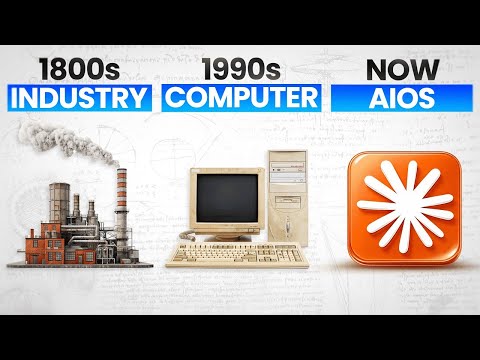
- The industrial revolution and the internet were major shifts; the AIOS represents the third shift, changing how businesses are fundamentally run.
- An AIOS is not a single tool but a system that connects to real data and understands your unique business context.
- AI-driven daily intelligence briefings allow founders to start their day with a complete, synthesized overview of their entire organization.
- Founders should audit every task to categorize it by AI automation potential to systematically reclaim their schedule.
- Implementing an AIOS enables a single founder to accomplish goals, such as million-dollar product launches, in days rather than quarters.
- The goal is to move 20% of work into 'must-dos' and 80% into open space for strategic growth.
- Avoiding tech bloat is essential; focusing on a unified model rather than disjointed hacks ensures long-term compounding benefits.
The Biggest Shift in Business Since the Internet Just Happened
Liam Ottley
Key Takeaways
- Shift your business management paradigm by implementing an integrated, layer-based AI Operating System (AIOS) rather than relying on fragmented, disjointed tools.
- Free up significant founder bandwidth by automating recurring operational tasks, allowing you to focus on high-leverage strategic initiatives.
- Drive compounding productivity gains by utilizing a contextualized AI system that understands your business strategy, team roles, and historical data.
Talking Points
Pro Analysis
The premise that AI should function as an integrated operating system rather than a collection of disparate tools is fundamentally correct. For modern organizations, the bottleneck is often the human overhead required to synthesize data siloed across different platforms. An AIOS addresses this by providing a unified cognitive layer.
Strategic Importance: This is critical because it forces leaders to move beyond the 'AI as a chatbot' phase. Organization leaders should view the AIOS as a foundational infrastructure project, similar to migrating to the cloud in the early 2010s. For employees, this transition necessitates a shift toward managing AI systems rather than manual process execution.
Contrarian Takeaway: While the speaker emphasizes building an AIOS to gain 'freedom,' the reality is that such systems often tighten the coupling between the founder and the business. By automating everything, you create a complex, high-dependency architecture that, if interrupted (e.g., API failures, platform changes), could leave a business unable to function 'manually.'
Next Steps: Leaders should start by mapping their current internal 'data silos' and identifying the top three most repetitive operational processes that consume the most time before attempting full-system automation.
Time saved:
Written by: 1 Minute Signal Editorial Team