
Why It Matters
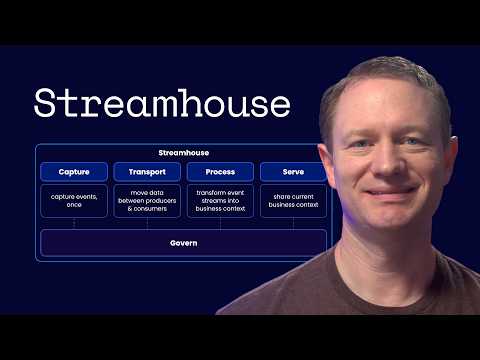
This architecture represents a shift from data-at-rest to data-in-motion as the primary source of truth. As AI agents move from experimental chat interfaces to autonomous operational roles, the requirement for 'freshness' becomes the most critical performance metric in the stack.
Strategic Implications
- Governance at Source: By moving to an event-driven stream house, organizations can apply governance policies to the stream itself, rather than trying to sanitize fragmented downstream caches.
- Engineering Efficiency: Embedding model inference directly into the streaming query allows for smaller, more agile team footprints, as it removes the infrastructure overhead of managing independent inference APIs.
Evidence & Hype Audit
- Evidence: The demo is functionally coherent and aligns with standard event-stream processing patterns (Flink).
- Hype: The term 'Stream house' is clearly a marketing-forward concept meant to provide a new category for a specific architectural shift. It relies on the assumption that agents will eventually manage most operational logic, which remains an industry vision rather than a universal current state.
Counterarguments
- Complexity: Many organizations struggle to maintain basic lakehouse pipelines. Adding a live stream house layer introduces significant operational complexity that might not be justified for businesses without high-velocity telemetry.
- Vendor Lock-in: The proposal relies heavily on integrating various streaming and AI-query components which are often vendor-specific (like the Confluent/Flink ecosystem), potentially locking organizations into a specific tooling stack.
Who Should Care
- Data Architects: Evaluating if their current lakehouse architecture can support real-time agentic workloads.
- AI/ML Engineers: Interested in reducing inference latency by moving computation closer to the event ingestion point.
- Operations Leads: Responsible for automated systems where 'stale data' equates to 'financial or safety loss'.
What to Do Next
- Map existing data-dependent agents to identify which require 'current state' vs 'historical trends'.
- Conduct a latency audit on current batch ETL processes to identify which would cause failures if the data were 60 minutes stale.
- Evaluate the feasibility of using existing stream-processing infrastructure (like Flink) for simple anomaly detection before adopting a full stream house architecture.
- Establish a schema registry early, as event-driven architectures can break rapidly if data formats evolve without strict, centralized governance.