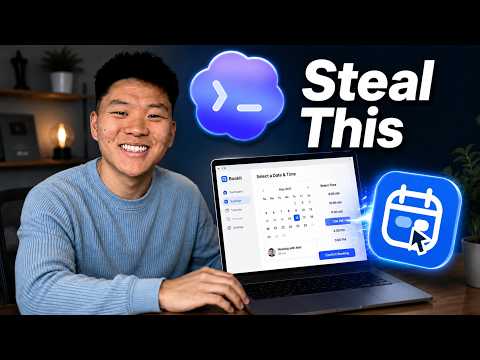
I Cloned Calendly and Now It’s Free Forever

Video thumbnail: I Cloned Calendly and Now It’s Free Forever
Aug 28, 202614m video lengthNate Herk | AI Automation

The Signal

A developer recently demonstrated a functional, Calendarly-style scheduling application named "Snag Time" built entirely through agentic AI coding over five days. The project showcases how multi-agent iterative loops can produce complex software, yet it also highlights significant gaps between a functional local prototype and a production-ready, feature-complete SaaS product.

The Case

The Build Process

  • The application resulted from a massive multi-phase prompt—research, planning, building, and testing—executed by 76 unique sub-agents over 334 total agent-hours.11:36
  • The author reports the project consumed over 32 billion input tokens and 47 million output tokens, resulting in an estimated $15,000 in total inference value, though it cost only $150 out-of-pocket by leveraging a $200/month subscription.12:23
  • The build required extensive iterative test-and-fix loops, which the author cites as the primary engine for functionality rather than a one-shot successful prompt.8:41

Product Capability and Limits

  • The demo successfully executes live calendar-state synchronization, including blocking availability after a manual "busy" entry, and processes payments via a sandbox Stripe flow.2:52
  • Despite these features, the author concedes the app is currently a localhost-only prototype that lacks the deep automation functionality standard in commercial tools like Calendarly.6:34
  • Agentic testing failed to identify intuitive UX issues, such as non-clickable progress bars that humans expected to interact with, forcing the author to perform manual interface redesigns.5:06

The 1 Minute Signal Take

While agentic AI can generate sophisticated internal tools at a fraction of the traditional cost, the author's experience demonstrates that such builds require manual oversight, performance tuning, and ongoing maintenance. This is a functional prototype for internal use, not a "set-and-forget" replacement for commercial SaaS infrastructure.

Pro Analysis

Why it matters

This demonstration marks a shift in software development where the 'infrastructure' of a SaaS is no longer a high-bar barrier to entry for individual operators. It illustrates how agentic swarms can lower the cost of initial architecture, moving from zero to a functional MVP in days rather than months.

Strategic implications

The reliance on high-token-volume agents suggests that the 'cost' of building software has shifted from human salary hours to compute inference costs. For small teams, this is a boon; for incumbents, it suggests that the defensibility of a platform based solely on 'feature sets' is rapidly eroding, as clones can now be generated at scale with limited manual oversight.

Evidence & Hype Audit

This content is high-signal but leans into 'free' narrative framing. The $15,000 inference figure is a useful metric for scope but should not be confused with market value. The evidence (live demo) is strong for functionality, but the claim of 'free forever' is factually loose—maintenance time and platform subscription costs are real recurring expenses.

Counterarguments

Critics would argue that this is merely a 'demo-ready' shell. The lack of production-level security, true reliability at scale, and missing automation features mean that for any business requiring uptime guarantees, this DIY approach is actually more expensive than a predictable monthly SaaS subscription fee.

Who should care

  • Independent Builders: To understand the workflow of using sub-agents for iterative coding.
  • SaaS Founders: To assess the speed at which their features can be replicated by automated tooling.
  • Product Managers: To observe where human-in-the-loop design currently beats autonomous agents.

What to do next

  • Audit existing internal tools to determine if they can be replaced by low-maintenance agent-built clones.
  • Practice defining multi-phase agent loops (Research → Planning → Build → Test) to improve code quality in your own projects.
  • Evaluate the hidden cost of 'free' software by calculating the time-value of ongoing prompt-based maintenance.
  • Perform a manual UX usability study on any agent-generated code before deploying to external users.
Time saved:10m 54s

Share this

Tags

Written by: 1 Minute Signal Editorial Team