
- The transition from simple coding snippets to full system architecture when scraping scales.
- How to use residential proxies at scale to avoid IP blacklisting.
- Parsing HTML efficiently using Beautifulsoup after acquiring desired page content.
- Organizing multi-regional e-commerce data using standardized product IDs.
- Storing vectorized product embeddings to facilitate fast AI-driven data retrieval.
- Using Docker Compose to manage complex dependencies in multi-service data applications.
- Designing an event-driven monitoring layer to observe job status and failures.
How to Design a Production-Grade System in Python
Tech With Tim
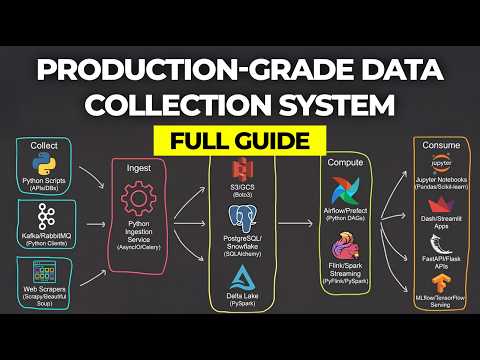
This video demonstrates the construction of a robust, production-grade web scraping system designed to collect multi-regional e-commerce data using Python and proxy networks. It highlights the transformation of simple scripts into an event-driven architecture that supports historical data storage, vector embeddings, and an AI-enabled natural language interface for data analysis.
Key Takeaways
- Shift from simple scripts to event-driven architectures is necessary for handling blocking, data inconsistency, and large-scale data collection.
- Integrating residential proxy networks is critical for bypassing anti-bot measures and scraping content from specific global regions.
- Combining vector databases with LLMs enables powerful, conversational querying of structured and unstructured scraped data.
- Containerization via Docker Compose simplifies the development, deployment, and management of complex multi-service scraping workflows.
Talking Points
Pro Analysis
Strategic Importance
This architecture is strategically vital for companies relying on market intelligence. In e-commerce, price agility is a key competitive advantage; having real-time data from global markets allows for dynamic pricing and trend identification that manual inspection cannot provide.
Who Should Care
- Data Engineers: Anyone building pipelines that require high-availability data collection from public web sources.
- E-commerce Analysts: Professionals needing to track competitor pricing across disparate global territories.
- AI Developers: Those interested in the "RAG" (Retrieval-Augmented Generation) pattern, where vector databases act as the memory for LLM-powered business apps.
The Non-Obvious Takeaway
The speaker demonstrates that the most successful systems are not just about the scraper, but the orchestration and debugging layer. Instead of focusing purely on how to extract HTML, the value lies in building a system that reports why it failed, allowing for automated retries and clear monitoring. Often, developers over-index on the scraping speed, but the true bottleneck in production is the stability of a 24/7 data-gathering operation.
Time saved:
Written by: 1 Minute Signal Editorial Team