Managed Deep Agents - Intro

Video thumbnail: Managed Deep Agents - Intro
Aug 19, 20261m 55s video lengthLangChain

The Signal

LangChain — a platform for agent engineering — is introducing a managed deep agent system designed to separate user-defined business logic from execution infrastructure. The series frames this as a production-ready workflow, though the claim that it is the simplest method for deployment remains marketing rhetoric rather than a demonstrated technical benchmark.

The Case

Architecture and Structure

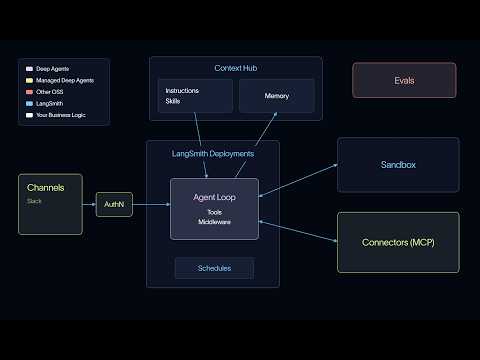
  • The system divides responsibilities: you provide the business logic, rules, tools, and skills, while LangChain provides the harness and managed runtime.0:34
  • A deep agent is structured as a folder containing modular components, specifically instructions, skills, memory, and middleware, which the series intends to detail in future episodes.0:53
  • The managed runtime includes an agent server, sandboxes, and scheduling services to abstract away the operational burden of production agents.

Onboarding and Logistics

  • Users must create a LangSmith account and generate an API key in the settings menu to begin the series.
  • LangSmith offers a free tier that supports agent creation, local execution, and testing in the platform's Agent Studio.1:23
  • Deployment is the only step explicitly excluded from the free tier, as the series aims to transition users toward a production-ready final product.

The 1 Minute Signal Take

This is a foundational walkthrough for developers looking to move from experimental agent code to managed production workflows. You can follow the entire learning path for free, provided you are prepared to handle the deployment costs only when the project is ready for production.

Pro Analysis

Why It Matters

The transition to 'managed' services for AI agents reflects the maturation of the LLM application stack. By commoditizing the infrastructure (servers, sandboxes, scheduling), LangChain is attempting to lower the barrier to entry for developers who want to deploy agents without becoming DevOps engineers.

Strategic Implications

This approach pushes developers toward a standardized folder-based project structure. This creates an ecosystem where agent components (skills, instructions) could theoretically become portable, allowing developers to switch between different agent frameworks while keeping their core logic intact.

Evidence & Hype Audit

The content is high-level framing. While the claim that this is the "simplest way" to build agents is standard marketing rhetoric, the separation of concerns (logic vs. infrastructure) is a proven software engineering pattern. There is no technical deep-dive or benchmark data provided, but as an introductory video, it serves its purpose as a roadmap.

Counterarguments

Critics might argue that "managed" platforms introduce vendor lock-in. By relying on the LangChain runtime, developers may find it difficult to migrate their agent folder structures to other environments or cloud providers in the future.

Who Should Care

  • Software Engineers: Those looking to build agents that need to run continuously rather than as ephemeral scripts.
  • Product Leads: Anyone aiming to scale AI prototypes into production-ready tools.

What To Do Next

  • Create a LangSmith account and generate an API key to enable local testing.
  • Identify the core business logic you intend to convert into an agent.
  • Organize your existing tools and memory requirements into separate modules.
  • Complete the 'quick start' guide in the next module to validate your environment.

Share this

Tags

Written by: 1 Minute Signal Editorial Team