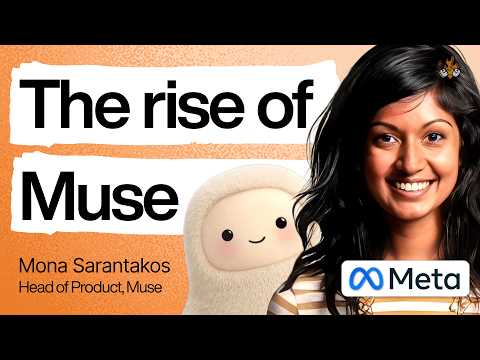
Meta’s Muse: How we launched the most successful consumer product this year | Mona Sarantakos

Video thumbnail: Meta’s Muse: How we launched the most successful consumer product this year | Mona Sarantakos
Nov 15, 20261h 27m 16s video lengthLenny's Podcast

The Signal

Muse, the personal AI agent from Meta, originated from an informal, engineering-led prototype built after leadership identified a gap in existing agentic experiences. The product’s success is defined by a seven-month launch delay, which the team used to establish safety and trust benchmarks—a crucial tradeoff for an agent accessing deep personal context. While Muse is now one of Meta's primary consumer AI efforts, the team remains actively split on the ideal UI patterns for long-running assistant behavior.

The Case

Origins and Leadership

  • The product began as an ad-hoc experiment after Nat Friedman, an early tech investor and executive, pinged the team to try an agent tool. Development remained outside standard corporate review cycles, relying on direct, high-intensity feedback from Meta leadership.3:23
  • Leaders like Mark Zuckerberg reframed the project from a task-completion assistant into a goal-aligned partner, which led to the creation of a 'goals tab' and a focus on proactive, long-term memory.21:29

Trust and Identity

  • The team enforced a strict 'trust is a must' mandate, delaying the public launch by seven months to harden security, reliability, and red-teaming against potential harms.0:35
  • Jolly, the product's mascot, was retained despite internal pushback because the team believed a personal agent should avoid corporate branding to maintain a sense of user ownership.

Operational Evolution

  • Traditional product analytics failed to capture multi-turn agent conversations, so the team created 'swarms'—independent AI agents that analyze real user patterns—to generate synthetic data and performance evals.38:20
  • Shopping emerged as a high-volume use case unexpectedly, forcing the team to move beyond their initial home-automation focus and adapt evals for distributed, multi-vendor purchases.32:05

Product Tension

  • Internal debate persists regarding whether a 'main chat' with long-running memory is superior to a 'side chat' threaded model; the current product compromises by supporting both.53:52
  • PM roles have shifted from document-heavy planning to rapid prototyping and 'taste' management, as the team prioritizes human-curated behavioral specs over fully AI-generated system prompts.62:08

The 1 Minute Signal Take

Muse represents a shift toward agents that prioritize personal context and goal-alignment over mere task execution, accepting a longer development cycle to mitigate the high risks of granting AI autonomous action. The team's success in navigating this transition suggests that for high-agency consumer tools, internal autonomy and a high-fidelity trust bar are more valuable than aggressive speed-to-market.

Pro Analysis

Why It Matters

Meta’s Muse represents a transition from 'chatbots' to 'agents' that possess persistent memory and the capability to take action. This shift requires a fundamental change in how products are built, evaluated, and secured, moving away from simple accuracy metrics toward complex trust and behavioral alignment.

Strategic Implications

The strategy of keeping the development team small while maintaining deep, informal access to top leadership allows for high-velocity iteration that larger organizations typically lose. The move toward 'swarms' suggests that the future of AI development lies in self-testing systems, where the product itself provides the data necessary for its own improvement.

Evidence & Hype Audit

The account is highly trustworthy regarding internal processes, team structure, and decision-making logic. However, the claims about Muse being the 'most successful' consumer product remain marketing-adjacent, as the speaker provides no concrete verification of these metrics compared to industry competitors.

Counterarguments

Critics might argue that the seven-month delay allowed competitors to define the 'AI assistant' category, potentially trading long-term market influence for short-term risk management. Furthermore, relying on human-curated system prompts may eventually fail to scale as the complexity of the agent’s tasks grows, creating a bottleneck that human intuition cannot solve.

Role-Specific Takeaways

  • Product Managers: Stop writing long PRDs. Focus on building high-fidelity prototypes and developing an eye for 'product taste.'
  • Engineers: Invest in agent-based evaluation pipelines; traditional testing metrics are insufficient for multi-turn assistant products.
  • Founders: Protect your small, high-density teams from bureaucratic review cycles to keep the 'let them cook' culture alive.

What to Do Next

  • Conduct a gap analysis of your current evaluation pipeline to see if it supports multi-turn behavior.
  • Replace static performance dashboards with qualitative feedback loops generated by agent swarms.
  • Implement a 'privacy-by-design' audit for all inter-agent communication channels.
  • Shift PM hiring criteria to favor product taste and prototype velocity over historical documentation experience.
Time saved:1h 23m 41s

Share this

Tags

Written by: 1 Minute Signal Editorial Team