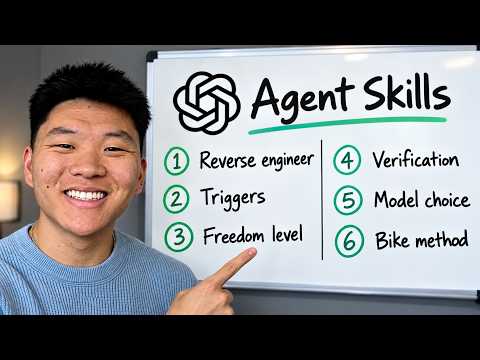
How to Build Codex Skills Better than 99% of People

Video thumbnail: How to Build Codex Skills Better than 99% of People
Sep 19, 202627m 5s video lengthNate Herk | AI Automation

The Signal

Building effective AI skills—codified recipes that allow agents to replicate specific workflows—requires reverse-engineering from a known-good output, not abstract goals. The central trade-off is between task determinism and agent autonomy; rigid rules work for data entry, while judgment-heavy tasks necessitate flexible verification loops to manage variable results.

The Case

The Skill Method

  • A skill—defined as a documented recipe stored in project-specific folders like aagents/skills—should perform exactly one job triggered by one specific event to prevent the failures seen in overly broad "run the marketing team" prompts.3:42
  • Skill files use markdown and YAML front matter to instruct an agent on desired outputs; the speaker recommends reverse-engineering these by starting with a finished deliverable to ensure the agent understands the definition of done.1:57

Verification and Iteration

  • Verification is the most critical layer, with the speaker using a combination of objective rule-based checks and subjective LLM-as-judge reviews to perform tasks like screenshot cropping, redaction, and narrative alignment.9:07
  • The "bike method" of maintenance means skills are never finished: the speaker continuously feeds back corrections—such as fixing partial screenshots or poor image placement—to evolve the process over dozens of iterations.14:02

Model Comparison

  • Live tests on an X-article generation skill revealed that model capability does not always track with performance; while the speaker generally prefers the model Astra, a run showed Luna produced a stronger, more usable article than Terra despite Terra being theoretically more capable.17:08
  • Users should walk skills down through available models and effort settings, benchmarking results against a QA report containing metrics like screenshot count and text block headers to find the cheapest option that maintains quality.12:33

The 1 Minute Signal Take

Do not treat AI skills as static instructions; they are evolving production artifacts that demand constant feedback loops to be reliable. Since model performance varies significantly by task, verify output quality with objective metrics rather than relying on abstract model capability rankings.

Pro Analysis

Why It Matters

This framework marks a transition from 'prompt engineering'—which is often brittle and ephemeral—to 'agent engineering,' which treats AI logic as a version-controlled, testable software product. For organizations, this approach reduces the overhead of constant human supervision by embedding QA into the production line itself.

Strategic Implications

By moving from vague instructions to reverse-engineered recipes, companies can turn complex, subjective workflows (like market analysis or content production) into automated systems. This reduces the 'human-in-the-loop' burden by an order of magnitude, provided the initial reverse-engineering phase is performed with sufficient rigor.

Evidence & Hype Audit

  • Strengths: The video provides a clear, actionable workflow with transparent examples and a live demonstration of failure cases (the model comparisons). It avoids theoretical abstractions in favor of actual directory structures and file formats.
  • Weaknesses: The speaker uses heavy marketing language (e.g., 'better than 99% of people') that is not empirically supported. The comparison of models (Astra/Soul/Terra/Luna) is anecdotal; a single run is insufficient to make definitive claims about model capability hierarchies.

Counterarguments

Critics might argue that this 'agent-as-apprentice' model requires such intense maintenance that it offsets the productivity gains. If a skill requires 25 iterations to reach maturity, does the time saved actually exceed the time spent on development?

Role-Specific Takeaways

  • Developers: Focus on the skill.md structure as a way to modularize agent behavior.
  • Product Managers: Use the 'reverse-engineering' concept to define feature requirements for AI features.
  • Content/Operations Leads: Apply the 'verification loop' to your internal quality control processes.

What to do next

  • Audit your current manual tasks for one candidate process suitable for reverse-engineering.
  • Create a directory structure for your local agent skills (e.g., aagents/skills).
  • Draft a single skill.md file using YAML front matter for a repeatable task.
  • Run that task three times with different models and log the output variations.
  • Identify the specific failure point in your first run and write the 'correction feedback' as an explicit instruction.
Time saved:23m 47s

Share this

Tags

Written by: 1 Minute Signal Editorial Team