
- AI-native builders that lack proprietary data or infrastructure are effectively thin wrappers prone to disruption.
- Ownership of the runtime environment and deployment infrastructure creates a stronger moat than UI customization.
- In an agentic economy, trust signals become mandatory for agents to transact with one another safely.
- Context is the primary differentiator that turns a generic AI chatbot into a functional junior employee.
- Supply of software is becoming infinite, shifting the scarcity from production to expert curation.
- Human taste remains the ultimate editorial filter for product-market fit in a world of AI-generated content.
- Liability management is a growing business category as autonomous agents begin handling financial and mission-critical tasks.
- Established platforms like Google, Notion, and Salesforce are uniquely positioned as 'context players' due to their data gravity.
There Are Only 5 Safe Places to Build in AI Right Now. Are You in One?
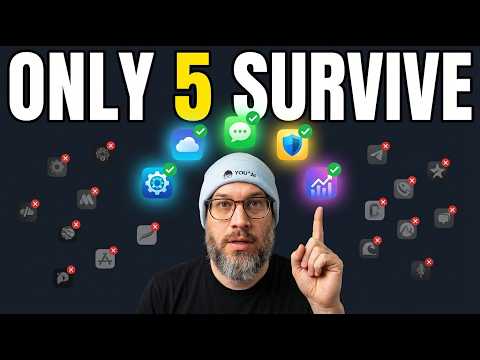
AI News & Strategy Daily | Nate B Jones
This video examines how to build sustainable software businesses in the age of AI by focusing on value layers that model makers cannot replicate.
Key Takeaways
- AI model providers are commoditizing the build layer, making basic wrappers obsolete.
- Sustainable businesses must focus on five non-replicable pillars: trust, context, distribution, taste, and liability.
- Winners will be companies that own structural assets like data gravity, deployment infrastructure, or regulatory compliance.
- The future of the web depends on businesses that provide the human judgment, accountability, and curation that AI on its own lacks.
Talking Points
Pro Analysis
This analysis is strategically significant because it pivots the conversation from 'AI capability' to 'market viability.' Most builders fixate on prompt engineering or model performance, yet these are increasingly commoditized features. By categorizing the web into structural verticals (Trust, Context, Distribution, Taste, Liability), the speaker provides a clear framework for long-term survival.
Why this matters
This is essential reading for founders and investors who need to evaluate if a product is a 'feature' that will be absorbed by a foundation model or a 'platform' capable of ecosystem lock-in.
Contrarian Takeaway
While most developers are trying to build proprietary models to gain an edge, the speaker argues that the real winners are not necessarily the best coders or model builders, but the 'trust and liability' brokers. The most defensible territory in the future may not be the intelligence layer at all, but the mundane layers of compliance and verification that AI is structurally prevented from assuming due to legal and moral imperatives.
Time saved:
Written by: 1 Minute Signal Editorial Team