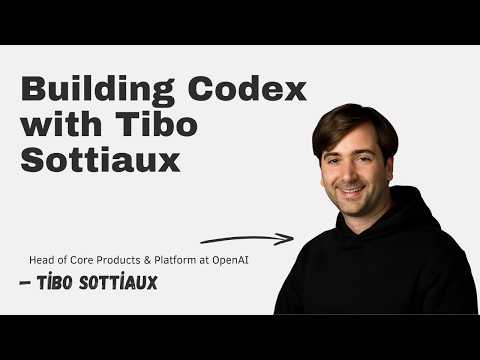
Building Codex with Tibo Sottiaux

Video thumbnail: Building Codex with Tibo Sottiaux
Sep 9, 20261h 14m 23s video lengthThe Pragmatic Engineer

The Signal

OpenAI designed Codex as a separable, model-agnostic agent core meant to accelerate development. By embedding the tool into internal workflows and relying on a Rust-based architecture, the team aims to replace manual coding tasks with automated systems, shifting human engineering focus toward architecture and intent rather than verification and security.

The Case

Architectural Design

  • Codex was engineered as a separable agent core, ensuring the underlying logic exists independently of the product interface.18:58
  • The team intentionally chose Rust for its compile-time validation, security, and performance, even though they acknowledge other languages could have technically functioned.0:20
  • OpenAI maintains a model-agnostic strategy, allowing users to swap models to preserve optionality and ensure the product succeeds on merit rather than lock-in.26:18

Engineering Workflow

  • The internal operating model defaults to asking Codex for answers before escalating to humans, as the agent has access to Slack, documentation, and codebase history.
  • Human code review is transitioning away from correctness and security enforcement—which machines now handle—toward high-level architectural and product-intent discussions.
  • Maintenance tasks like dependency upgrades and security patching are increasingly automated, compressing development cycles that once took months into days or weeks.0:43

Scaling and Integration

  • The Codex-ChatGPT merge was a complex systems-level unification, combining a local-first agent stack with a managed cloud-based environment.63:29
  • The team views the current 'harness' as a temporary scaffold; as model capabilities grow, they expect the harness instructions and developer messages to shrink.37:36
  • While local sandboxing remains the current default, the team expects a shift toward more cloud-orchestrated environments as agentic capability allows for more autonomous setup.35:15

The 1 Minute Signal Take

Codex represents a deliberate shift in software engineering where human oversight is being abstracted toward conceptual design while the mechanical 'tax' of maintenance and verification is automated. While the team remains transparent about their open-source and model-agnostic strategies, the true test will be whether their 'personal AGI' vision can deliver meaningful architectural quality as the harness crutches are eventually removed.

Pro Analysis

Why It Matters

Codex represents a transition from viewing AI as a "tool for writing code" to a "platform for autonomous system maintenan...
Full analysis always available on Pro.

Time saved:1h 12m 35s

Share this

Tags

Written by: 1 Minute Signal Editorial Team