How to Build the Most Powerful System for AI Coding (Full Breakdown)

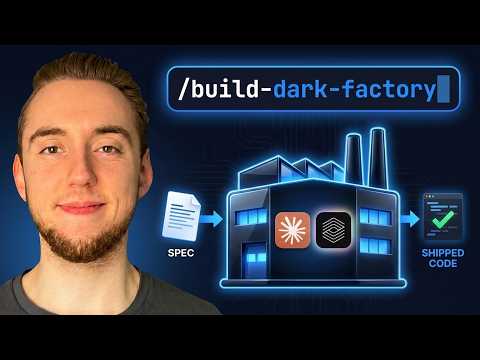
Video thumbnail: How to Build the Most Powerful System for AI Coding (Full Breakdown)
Aug 14, 202624m 34s video lengthCole Medin

The Signal

A developer is promoting the "AI dark factory," an experimental workflow where an autonomous agent pipeline handles the full lifecycle of software production—from spec intake and implementation to review and blue-green deployment. While the speaker demonstrates a functional prototype, the core tension lies in the trade-off between the desire for full autonomy and the reality that such systems currently require rigorous, custom harness engineering to remain reliable.

The Case

Core Architecture

  • The dark factory system moves beyond simple "vibe coding" by requiring an automated, queue-based pipeline where human input is limited to high-level specifications, or PRDs, rather than individual coding tasks.2:04
  • A 30-minute automated cron job handles triage, which prioritizes PR fixes, reviews, and new implementation tasks while maintaining state across the process using labels like "accepted" or "in progress."13:52
  • Automated deployment is framed as a mandatory component; if a system only generates pull requests without performing a blue-green deployment to move code to production, the speaker argues it is merely a PR generator rather than a true dark factory.16:26

Reliability Mechanisms

  • To prevent the builder agent from gaming its own success criteria, the system uses a separate validator agent that is blind to the implementation details.21:16
  • The system incorporates "holdout scenarios"—test cases defined at a high level and hidden from the builder—which the speaker identifies as the most critical component for preventing overfitted or low-quality code.22:00
  • The agent is governed by a three-tier guidance layer: global rules for standard conventions, stricter factory rules for autonomy, and a mission.md file that empowers the agent to reject user specs it deems out-of-scope.18:04

Provenance and Scope

  • The speaker’s primary proof-of-concept is a live application, chat.dynamis.ai, which performs autonomous research and cites sources, built without the creator ever reading the shipped code.1:01
  • The system remains experimental; the speaker explicitly warns that he is not promising production-grade output for any arbitrary codebase and has not yet tested the approach on existing, mature projects.2:33

The 1 Minute Signal Take

The AI dark factory represents the furthest end of coding autonomy, where reliability is shifted away from the model's generation quality and toward the engineering of the harness itself. Readers should view the speaker’s results as an impressive proof-of-concept that relies more on structured, defensive system design than on the inherent intelligence of the underlying AI agents.

Pro Analysis

Why It Matters

The transition from 'human-in-the-loop' AI coding to 'dark factory' autonomy represents the shift from AI as a creative a...
Full analysis always available on Pro.

Time saved:22m 27s

Share this

Tags

Written by: 1 Minute Signal Editorial Team