why is every company building a software factory?

Video thumbnail: why is every company building a software factory?
Jul 29, 20269m 30s video lengthJaymin West

The Signal

Engineering teams at high-scale companies are converging on a shared architecture for agentic development, dubbed a "software factory." This shift moves the industry from simple agent loops toward structured, observability-heavy infrastructure capable of managing code production at scale. While the speaker asserts this model is now the mature industry standard, it remains a contested vision of how human oversight should integrate with autonomous system outputs.

The Case

The Software Factory Architecture

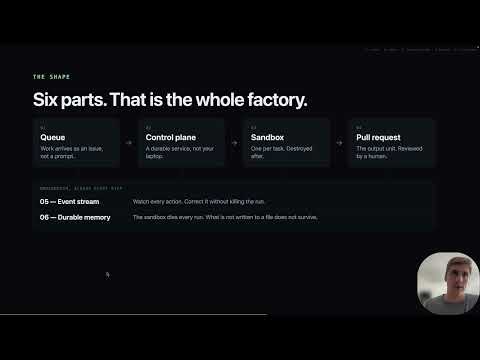
  • The model replaces ad-hoc prompt engineering with a rigorous pipeline: a work queue issues tasks to agents operating in isolated, ephemeral sandboxes—often managed via Kubernetes—that are destroyed upon completion.2:59
  • Beneath this process, two layers are required for maturity: an event stream for real-time token tracing, steering, and debugging, and durable Git-backed memory to persist work beyond the life of the sandbox.5:31
  • Moving tasks into a queue system allows organizations to treat agentic development as infrastructure, rather than a collection of local scripts that fail to scale once moved beyond a solo developer's machine.2:35

The Human Bottleneck

  • The transition to an automated factory has shifted the core engineering challenge from code generation—which the speaker claims is now cheap and easy—to verification and safety.1:42
  • Despite the rise of agentic tools, the speaker argues that fully autonomous "dark factories" remain unfeasible in the near term; human engineers are still necessary for work assignment, permission management, and final pull request review.4:24

Open-Source Implementation

  • Warren is the speaker’s open-source, model-agnostic implementation of this software-factory pattern, designed to be customizable across various providers and control planes.6:43
  • A public, read-only demo at app.warren.run allows users to inspect run logs in real-time, though the ability to spawn runs is restricted and the current version lacks the suspend/resume capabilities found in private enterprise systems.7:29

The 1 Minute Signal Take

The convergence on this architecture suggests that the "agentic" era is maturing from individual chat-based experimentation into a formal industrial pipeline focused on observability. Organizations should prioritize building these verification primitives now, as the bottleneck in agentic systems is clearly moving from the ability to output code to the ability to reliably trace and audit it.

Pro Analysis

Why It Matters

The transition from experimental AI agent use to 'Software Factory' architectures signals that we are moving out of the h...
Full analysis always available on Pro.

Time saved:7m 33s

Share this

Tags

Written by: 1 Minute Signal Editorial Team