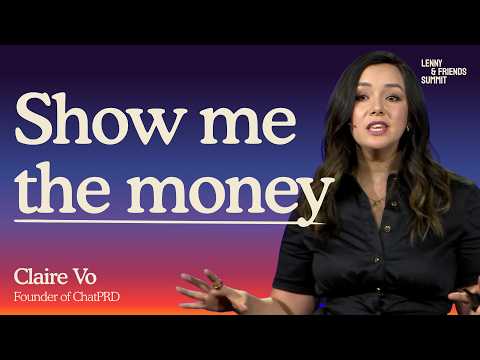
The last roadmap | Claire Vo

Video thumbnail: The last roadmap | Claire Vo
Sep 24, 202623m 58s video lengthLenny's Podcast

The Signal

AI has inverted the product management bottleneck, shifting the primary constraint from engineering capacity to strategic conviction. While automated agents now allow teams to build nearly anything on demand, the speaker argues that traditional feature-based roadmaps have become dangerous traps that accelerate mediocrity, parity-chasing, and feature churn without delivering actual business progress.

The Case

The Failure of Abundance

  • AI tools like autonomous coding agents and LLMs have enabled extreme iteration, with the speaker noting their own team re-architected a product 70 times simply because they could.8:12
  • The "backlog trap" occurs when AI builds everything on a list, creating the illusion of progress while failing to solve meaningful customer problems.10:08
  • The speaker’s own successful technical build—a product graph designed for writing PRDs—was abandoned because it merely matched competitor features without offering true differentiation.6:38

Moving to Conviction-Based Planning

  • The speaker suggests replacing static feature-and-date spreadsheets with an "ambition map" centered on durable convictions and clear evidence requirements.19:54
  • Teams should treat features as disposable probes or experiments, reserving "promise" status—and enterprise-grade stability—only for commitments backed by high-confidence evidence.18:44
  • "Good stubbornness" involves staying focused on a specific customer problem while being willing to aggressively pivot the solution form based on real-world testing.17:15

The 1 Minute Signal Take

The core takeaway is that in an era of machine-speed execution, your product roadmap is no longer a plan for building, but a framework for proving value. You must stop equating shipping volume with business success and start defining what evidence would actually justify your bets.

Pro Analysis

Why It Matters

This talk marks a fundamental shift in product management philosophy. By declaring the traditional roadmap 'dead,' Vo captures the growing frustration of product leaders who find their teams moving faster than ever while feeling less impactful. It highlights the transition from 'execution-as-a-service' to 'strategy-as-a-service.'

Strategic Implications

Organizations that continue to use feature-date roadmaps risk 'innovation debt'—moving at high velocity toward features that provide no differentiation. Leaders must invest in 'evidence infrastructure'—tools and culture that make it easy to kill bad ideas quickly—rather than just investing in CI/CD or AI coding agents.

Evidence & Hype Audit

This is a high-conviction, experience-based argument rather than a quantitative data-set. It leans on the speaker's personal 'Grock bot' experience, which provides credibility but may not scale to highly regulated enterprise environments where commitment-based roadmaps are a contractual necessity.

Counterarguments

Critics might point out that 'roadmap zero' ignores the reality of organizational alignment. In large enterprises, the roadmap is a coordination tool that keeps Sales, Marketing, and Support synchronized. Without a shared feature timeline, internal friction may skyrocket.

Who Should Care

  • Product Leaders: To rethink their team's cadence and prioritization metrics.
  • Founders: To understand the danger of scaling before finding product-market conviction.
  • Engineering Managers: To shift focus from PR throughput to outcome-based experimentation.

What to Do Next

  • Conduct a 'conviction audit' on your current roadmap items.
  • Define one 'big swing' experiment for the next quarter.
  • Implement a formal taxonomy for differentiating probes, experiments, and promises.
  • Build a 'truth trigger' for every major feature—pre-define exactly what data leads to its deletion.
Time saved:21m 17s

Share this

Tags

Written by: 1 Minute Signal Editorial Team