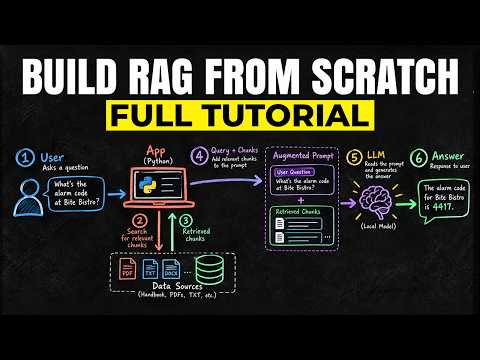
How to Build RAG From Scratch in 50 Lines of Python - Full Tutorial

Video thumbnail: How to Build RAG From Scratch in 50 Lines of Python - Full Tutorial
Oct 30, 202626m 34s video lengthTech With Tim

The Signal

A minimal Retrieval-Augmented Generation (RAG) system can be prototyped in roughly 50 lines of Python by using local models via Ollama to query private documents. This approach bypasses cloud APIs for a self-hosted, private workflow, though it remains a toy implementation that lacks the robustness required for production environments.

The Case

  • The architecture relies on three core steps: chunking markdown text into paragraphs, converting those segments into 768-dimension numeric vectors using Nomic Embed Text, and performing cosine-similarity searches to find the most relevant context for a user question.
  • By injecting these retrieved chunks into the prompt of the Qwen3 4B Instruct model—specifically instructing it to answer only from the provided context—the system successfully retrieves specific internal facts like the “417” alarm code for a fictional coffee shop, Byte Bistro, which the model would otherwise hallucinate or ignore.1:05
  • Local execution is handled by an Ollama server running on localhost:11434, utilizing small-footprint models that enable privacy without necessitating expensive cloud compute or closed-source model subscriptions.5:44
  • The speaker explicitly notes that this prototype is a conceptual baseline; genuine production systems require additional infrastructure, including persistent vector databases like PGVector or Chroma, smarter document chunking, reranking models, and automated evaluation frameworks to ensure performance consistency.25:21
  • A sponsored segment frames this technical skill set as a survival requirement for engineers, citing a September 2026 study where 48% of surveyed office workers reported building a backup career and a reported surge in job postings mentioning AI-systems expertise.3:16

The 1 Minute Signal Take

This demo provides a clear, actionable entry point for understanding the mechanics of RAG by stripping away framework overhead. Readers should view the "under 50 lines" claim as a teaching heuristic rather than a production target, as real-world reliability hinges on the complex evaluation and reranking steps this prototype intentionally omits.

Pro Analysis

Why It Matters

This tutorial strips away the bloat of modern AI orchestration frameworks, exposing the raw mechanism of RAG. For developers, this provides the conceptual agency to debug and optimize systems that are usually hidden behind black-box API abstractions. Understanding these three steps—retrieval, augmentation, and generation—is the foundational skill for building any domain-specific AI.

Strategic Implications

As organizations shift from generic chatbots to systems that interact with internal private data, the ability to build and maintain custom retrieval pipelines is becoming a high-value skill. The transition from 'writing code from tickets' to 'owning AI production systems' reflects a broader market trend where technical literacy in system architecture is displacing simple task execution.

Evidence & Hype Audit

  • Trustworthiness: High for the technical demo; the implementation logic is standard and verifiable.
  • Hype: The labor-market claims (e.g., "the market isn’t paying for code from tickets") are speculative and serve the sponsor's promotional goals. The "under 50 lines" claim is a useful pedagogical frame but shouldn't be taken as a benchmark for production code quality.

Counterarguments

Critics might argue that teaching "from scratch" implementations is dangerous because it encourages developers to reinvent the wheel rather than using battle-tested libraries (like LangChain or LlamaIndex) that handle edge cases like document-parsing, token-limit management, and asynchronous retrieval pipelines.

Role-Specific Takeaways

  • Software Engineers: Use this to transition into AI-systems roles by mastering the integration of vector stores and LLM pipelines.
  • Technical Leads: Focus on the evaluation metrics rather than the model choice; the retrieval pipeline’s quality is the primary failure point in RAG.

What to Do Next

  • Reproduce the 50-line implementation to verify your local Ollama setup.
  • Replace the simple paragraph-splitter with a smarter chunking library (like tiktoken) to test if retrieval improves.
  • Integrate a vector database like Chroma to see how persistence changes your workflow.
  • Define a "Gold Standard" set of 10 questions for your documents and measure the system's current failure rate.
  • Add a reranking step and compare the before-and-after accuracy scores.
Time saved:23m 18s

Share this

Tags

Written by: 1 Minute Signal Editorial Team